 SFDIFY
- Write down the single biggest unknown about your idea — technical, design, or market.
- Match that unknown to the right tool: technical risk gets a POC, design risk gets a prototype, market risk gets an MVP.
- Set a pass/fail bar before you start, especially for a technical POC.
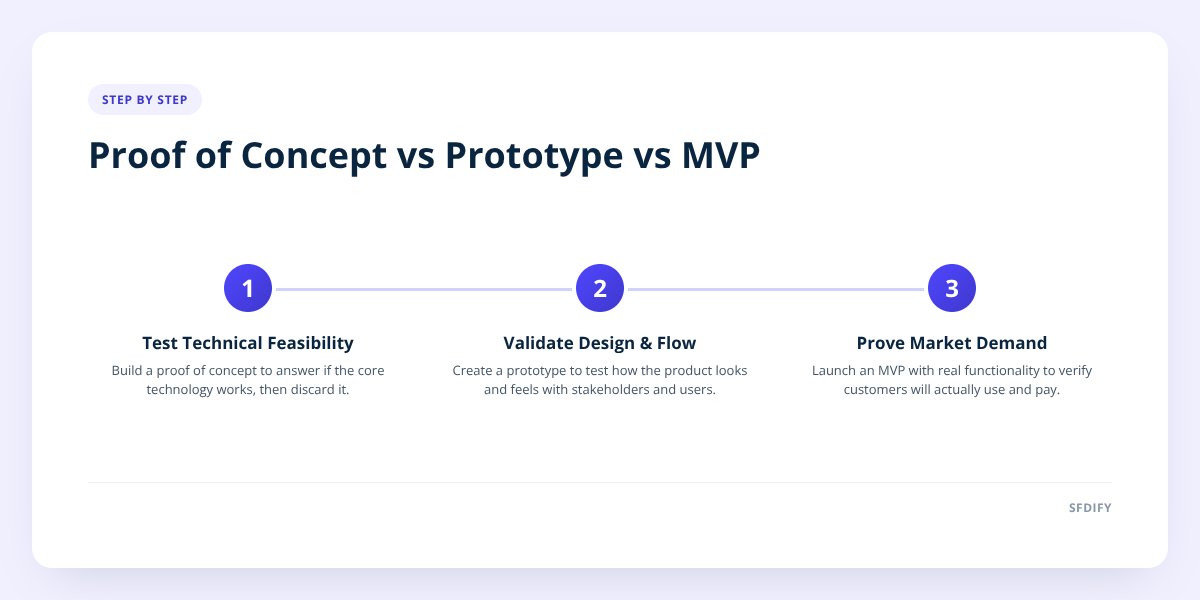
We have built all three for different reasons, and the most expensive mistake we see founders make is picking the wrong one for the question they are actually asking. A proof of concept answers "can this work at all." A prototype answers "what should this feel like." An MVP answers "will someone pay for this." Confuse the three and you either overspend proving something nobody doubted or underspend validating something that needed real engineering.
A proof of concept (POC) tests technical feasibility in days to a couple of weeks and is thrown away. A prototype tests look, feel, and flow, usually in one to three weeks, and is often half-functional or fully fake. An MVP is real, shippable software built to find out if customers will actually use and pay for it, and it typically takes six to twelve weeks depending on scope. Pick based on what you're unsure about: technology, design, or market.
- A proof of concept should never be customer-facing — it exists to answer one internal technical question, then gets discarded.
- A prototype is for stakeholders and early user feedback, not for production use; most are not built on code you'll keep.
- An MVP is live software with real users and, usually, real payment — we cover the cost breakdown in What an AI App Actually Costs to Build.
- Skipping straight to MVP when you haven't proven the core technology works is the single most common way founders burn their first round of funding.
1. What is a proof of concept actually for?
A proof of concept exists to answer one narrow question: is this technically possible with the approach we have in mind? Nothing else. Not whether users will like it, not what it should look like, not whether it's a business — just whether the hard technical part actually works.
Say you're building an AI agent that needs to read freight rate confirmations and extract load details automatically, the way our Yolda platform does for trucking dispatchers. Before writing a line of production code, the question isn't "will dispatchers like this" — it's "can a language model reliably pull pickup dates, rates, and commodity details out of a messy PDF with inconsistent formatting." That's a POC: a script, a test set of real documents, and a pass/fail answer.
A POC typically:
- Has no user interface, or a throwaway one
- Runs against a narrow, controlled dataset, not live data
- Gets built and discarded by the same person in days, not weeks
- Produces a yes/no answer, not a product
If your real uncertainty is "can the tech do this," spend money here first. If you already know the tech works and your uncertainty is about design or demand, a POC is wasted effort — you're answering a question nobody asked.
2. What is a prototype, and how is it different from a POC?
A prototype shows what the product will look and feel like, built for human eyes, not for proving technical feasibility. Where a POC is for engineers, a prototype is for everyone else — investors, early users, your own team deciding on a direction.
A prototype can be entirely fake. Click-through mockups in Figma, a mobile app shell with hardcoded data instead of a live backend, a chatbot that's actually a person typing responses behind the scenes — all legitimate prototypes, because the point is testing reaction to the interface and flow, not whether the system works end to end.
When we design something like the MyCheck experience — reminders, shared checklists, roadmap views across 13 languages — a prototype lets us watch someone actually tap through screens before any of that logic exists. Does the flow make sense? Do they understand what a "shared list" is without being told? That feedback is worth collecting before backend work starts, not after.
If you could answer the question with a drawing and a conversation, you don't need working code yet — build a prototype.
3. Where does an MVP actually fit?
A minimum viable product is real, working software built to test market demand, not just design or technical feasibility. This is the step people skip past accidentally, assuming a slick prototype or a working POC means they're ready to launch — they're not the same thing, and neither answers "will someone pay for this."
An MVP needs:
- A working backend, not hardcoded demo data
- Real user accounts and real data persistence
- Enough features to deliver actual value, and no more
- A way to measure whether people come back or pay
We wrote a full breakdown of what makes an MVP fundable in How to Build an AI MVP That Actually Attracts Investors, but the short version: investors aren't impressed by a prototype, because a prototype doesn't prove usage. An MVP does, because real people are putting in real data and, ideally, real money.
This is also where cost conversations get serious. A POC might cost a few thousand dollars and a week of an engineer's time. A prototype might run similarly or a bit more, since design work is involved. An MVP is a different category of investment — real architecture decisions, a real tech stack, real infrastructure that needs to hold up under actual use.
4. Proof of concept vs prototype vs MVP: side-by-side
| Proof of Concept | Prototype | MVP | |
|---|---|---|---|
| Answers | Can we build this at all? | What should it look and feel like? | Will people actually use or pay for it? |
| Built for | Engineers, internal decision-makers | Investors, stakeholders, early testers | Real end users |
| Typical timeline | Days to 2 weeks | 1 to 3 weeks | 6 to 12+ weeks |
| Is it functional? | Partially, narrowly | Often fake or partial | Fully functional, production-grade |
| Gets thrown away? | Yes, always | Usually | No — it becomes v1 of the product |
| Best for | Unproven or risky technology | Unclear or unvalidated design direction | Unproven market demand |
Who should pick what: if your biggest fear is "I don't know if the AI model can actually do this reliably," build a POC first and nothing else. If your biggest fear is "I don't know if users will understand this interface," build a prototype and test it on five real people before writing backend code. If you already know the tech works and the design makes sense, and your real fear is "I don't know if anyone will pay for this," stop prototyping and build the MVP — that's the only one of the three that can actually answer the question.
Most founders who come to us assuming they need an MVP actually need a POC first, because the real risk in their idea is technical, not commercial. We say so in the free consultation rather than quoting MVP pricing for a question a cheaper step could answer.
5. What does a realistic technical proof of concept look like in practice?
It looks like a small, scoped test against real data, not a demo deck. Here's roughly the shape of a POC test for a document-extraction problem, the kind we'd run before committing to a feature like automated rate confirmation parsing:
Input: 25 sample rate confirmation PDFs (varied formats)
Task: extract pickup date, rate, commodity, weight
Pass threshold: 90%+ field accuracy, no hallucinated values
Output: accuracy report, failure cases, cost per document
Decision: build / adjust approach / do not pursue
Notice what's missing: no UI, no user accounts, no deployment. Just a pass/fail test against a clear bar. If it fails, you've spent days finding that out instead of months. If it passes, you now know the MVP is worth building, because the hardest technical risk is retired.
This is also where AI products differ most from traditional software. A traditional CRM feature either works or it doesn't — you can usually tell from reading the code. An AI feature can look like it works in a demo and fail silently on real data, which is exactly why a scoped POC with a measurable pass threshold matters more here than almost anywhere else in software.
Checklist: deciding between a POC, prototype, and MVP
- Write down the single biggest unknown about your idea — technical, design, or market.
- Match that unknown to the right tool: technical risk gets a POC, design risk gets a prototype, market risk gets an MVP.
- Set a pass/fail bar before you start, especially for a technical POC.
- Keep the POC disposable — resist the urge to turn test code into production code.
- Test the prototype on real people outside your own team before approving a direction.
- Scope the MVP down to the smallest version that still lets a stranger pay or sign up.
- Confirm your core technical risk is already retired before committing MVP-level budget.
- Revisit this decision each time you add a genuinely new, unproven capability to the product.
How this shapes the way we build
We don't quote MVP pricing on day one of a conversation, because half the time the real question underneath "what would an app like this cost" is actually a feasibility question, not a product question. The free consultation exists to sort that out before any money moves — sometimes the right next step is a one-week technical test, not a twelve-week build.
That ordering is also why we build our own products the same way: Yolda's document-reading features started as feasibility tests, not features we committed to on faith. The same discipline applies whether it's our own roadmap or a client's.
If you're trying to figure out which of these three your idea actually needs, start a project with SFDIFY or reach out at info@sfdify.com, and we'll help you scope the right one before you spend money on the wrong one. You can also see how we approach the build itself on our MVP development page.
Checklist: deciding between a POC, prototype, and MVP
- Write down the single biggest unknown about your idea — technical, design, or market.
- Match that unknown to the right tool: technical risk gets a POC, design risk gets a prototype, market risk gets an MVP.
- Set a pass/fail bar before you start, especially for a technical POC.
- Keep the POC disposable — resist the urge to turn test code into production code.
- Test the prototype on real people outside your own team before approving a direction.
- Scope the MVP down to the smallest version that still lets a stranger pay or sign up.
- Confirm your core technical risk is already retired before committing MVP-level budget.
- Revisit this decision each time you add a genuinely new, unproven capability to the product.