SFDIFY

The best Brex alternative for most small businesses is Ramp, because its Free plan bundles a corporate card, expenses, bill pay and travel booking at $0 per user [1]. That matches Brex Essentials, which is also $0 per user per month [2]. Pick Navan if travel is most of your spend, BILL Spend & Expense if you already pay vendors through BILL, Mercury or Rho if you want banking and cards in one account, and Expensify if you mainly need expense reports.
How we chose
We started from what Brex sells to a small company: a corporate card, expense management, bill pay and travel booking on one plan [2]. Then we looked for products a founder or finance lead would shortlist against it and compared what each one charges, what the card earns, and which of those four jobs it covers. Everything below comes from the vendors' own homepages and pricing pages, read on 2026-11-24. We did not open accounts or apply for cards, so nothing here predicts approval or credit limits.
For reference, Brex Essentials includes travel booking, bill pay, reimbursements, accounting integrations and up to two entities [2]. Premium costs $12 per user per month and adds multiple expense policies, multi-entity support and live budgets [2]. Brex cards earn up to 7x back, and limits are based on "financial factors such as revenue or dollars raised" [3]. The same page notes that Brex LLC is a wholly owned subsidiary of Capital One [2].
Best Brex alternative options compared
| Product | Best for | Starting price | Notable |
|---|---|---|---|
| Ramp | Closest all-in-one match to Brex | $0/mo/user; Plus $15/mo/user plus platform fee [1] | Card, bill pay and travel on the Free plan [1] |
| Navan | Travel-heavy teams | Free for up to 300 employees; expense free for 5 users, then $15/user/month [4] | Cards earn up to 1.5% back [5] |
| BILL Spend & Expense | Companies already on BILL for payables | $0 per user per month [6] | Bill pay is a separate plan from $49/user/month [6] |
| Mercury | Startups that want banking and cards together | $0/mo [7] | 1.5% cashback on credit card spend [8] |
| Rho | Founders who want cashback without a credit check | $0 subscription and per-user fees [9] | Up to 2% with Rho Platinum, terms apply [10] |
| Expensify | Expense reports and receipt capture first | Collect $5 per member/month [11] | Card earns 1% on US purchases [11] |
Ramp — the closest match to Brex
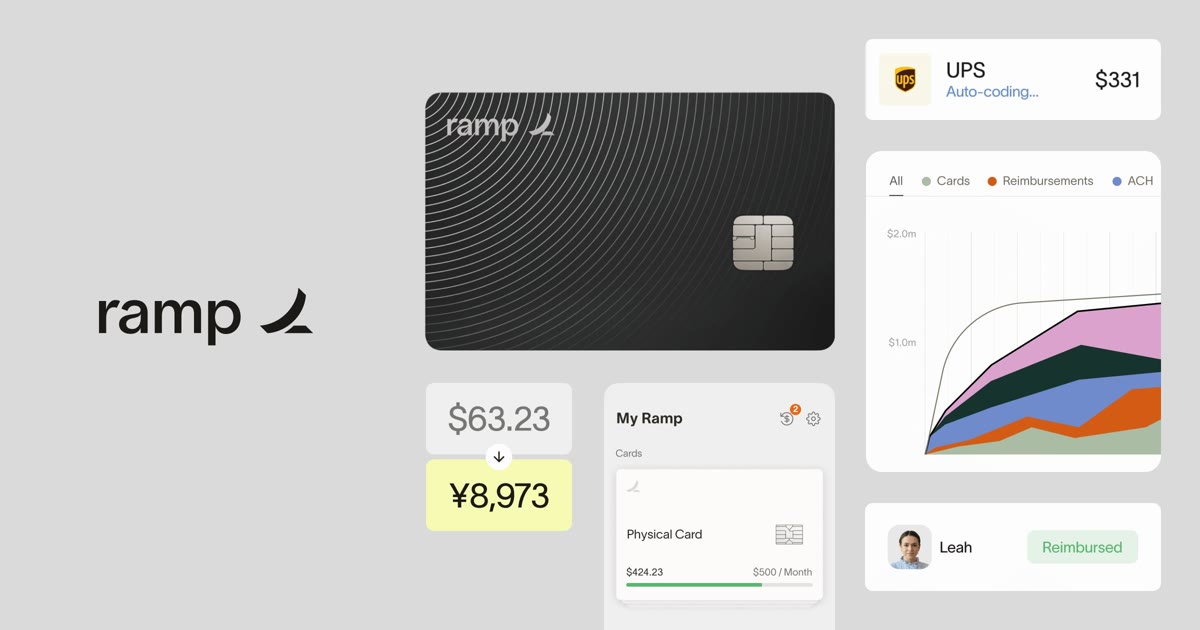
Ramp covers the same four jobs as Brex on its Free plan, which costs $0 per user per month [1]. If you are comparing Ramp vs Brex line by line, this is the one with the fewest gaps.
Verified features: The Free plan lists travel booking for flights, hotels and car rentals, bill payment by ACH, card, check and wire, unlimited cards, and QuickBooks Online and Xero integrations [1]. The card is a "Corporate liability charge card" [1].
Pricing: Plus is $15 per user per month "+ Platform fee based on team size," with 20% off on annual billing [1]. Plus adds NetSuite and Sage Intacct integrations and multi-entity support [1].
Strengths: Unlimited virtual and physical cards come "at no extra cost" [1]. Bill pay and travel sit in the free tier, so a small team can replace Brex Essentials without a new software fee.
Limitations: The Plus platform fee is not listed, so you need a quote to know the real cost. Ramp's pricing page gives no card rewards rate, while Brex advertises up to 7x [3]. Brex Essentials supports two entities for free [2], and Ramp puts multi-entity support on Plus.
Best fit: US small businesses on QuickBooks Online or Xero that want card, expenses, bill pay and travel without paying per seat.
Navan — for teams whose spend is mostly travel
Navan is a business travel and expense platform with its own corporate cards. Navan Business is free for companies with up to 300 employees [4].
Verified features: Navan cards "offer built-in expense management and up to 1.5% back," and Navan Connect links existing Visa, Mastercard or American Express corporate cards instead [5]. Navan Expense integrates with NetSuite, QuickBooks Online, Xero, Sage and Datev [5].
Pricing: Travel booking has no trip limit for companies with 300 or fewer employees, and Navan Expense is "free for the first 5 monthly expensing users, and then is $15 per user per month" [4].
Strengths: Booking, card and expense report live in one app. Reimbursements are paid via payroll or bank transfer, across 45 countries and 25 currencies [5]. You can keep your current cards and still use the expense side.
Limitations: Brex Essentials and Ramp Free charge nothing per expense user [2] [1], while Navan charges $15 per user after five. The pages we read do not describe vendor bill pay, so you would keep a separate accounts payable tool. Teams that rarely travel get less out of it.
Best fit: Companies with frequent travelers, or teams that want travel and expenses together while keeping their existing card program.
BILL Spend & Expense — for companies already paying bills in BILL
BILL Spend & Expense (formerly Divvy) combines company cards, expense tracking and spend controls [12]. The plan is "$0 per user per month and includes corporate cards, budgets, expense tracking, and access to credit lines from $1,000-$5M" [6].
Verified features: You set budgets, card limits and approval workflows, and employees can text a receipt photo to a BILL number [12]. It syncs with QuickBooks Online, NetSuite and Xero [12].
Pricing: Spend & Expense has no subscription or per-user software fee. Accounts payable and receivable are separate plans: Essentials at $49, Team at $65 and Corporate at $89 per user per month [6].
Strengths: Budgets by team or project suit companies that hand out spend that way. If your bookkeeper already pays vendors in BILL, cards and bills end up with one provider.
Limitations: Bill pay costs extra here, while Brex includes it in Essentials [2]. Credit lines "are not guaranteed and will be determined upon application approval" [6]. BILL mentions cash back and travel perks but gives no rate on the pages we read.
Best fit: Small and midsize businesses that budget by department and already use BILL for payables.
Mercury — banking first, with cards and bill pay included
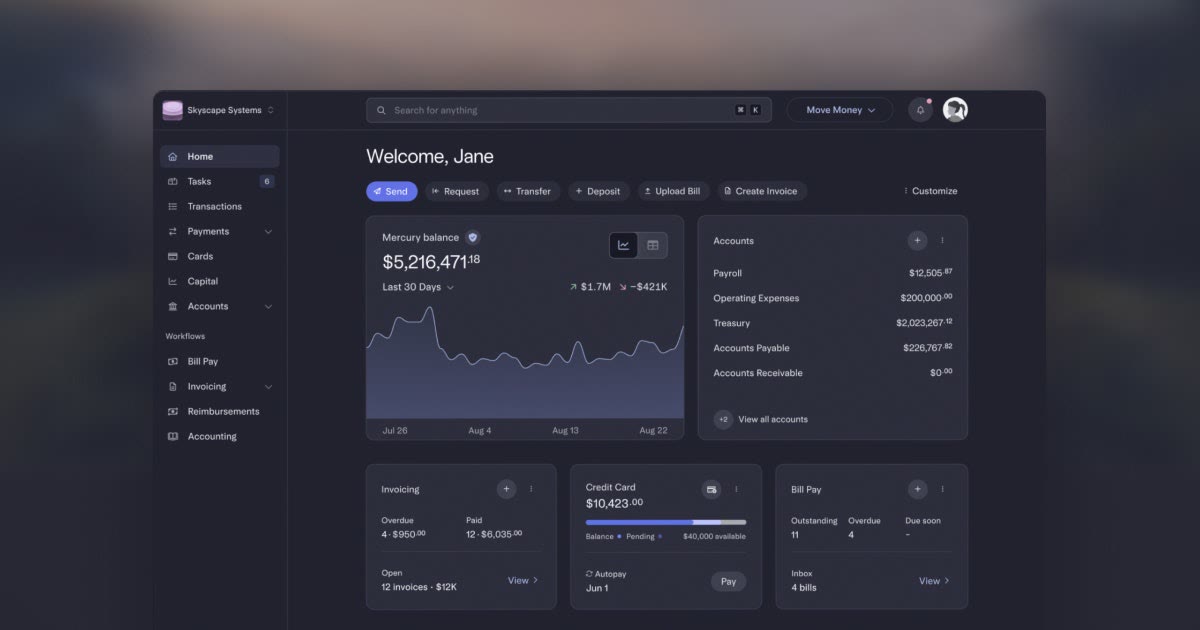
Mercury is a business banking platform with cards, expense management and bill pay built in. In a Brex vs Mercury decision, the main question is whether you want your checking account and your card program at the same company.
Verified features: Mercury offers business credit cards "as soon as day one — no minimums, credit checks, or personal guarantees," with 1.5% cashback on credit spend [8]. The $0 plan includes company cards, expense management, invoicing and bill pay [7].
Pricing: The base plan is $0 per month. Mercury Plus is listed at "$29.90 per month" and Pro at "$299 per month" [7]. Accounting sync covers QuickBooks Online, Xero and NetSuite [7].
Strengths: Flat 1.5% cashback is easy to value, and USD wires and ACH are $0 on every plan [7].
Limitations: Non-USD card transactions carry a 3% currency exchange fee [7]. The pages we read list no built-in travel booking, which Brex includes [2].
Best fit: Early-stage startups that want one account for banking, cards and vendor payments, with little foreign spend.
Rho — published cashback and no personal credit check
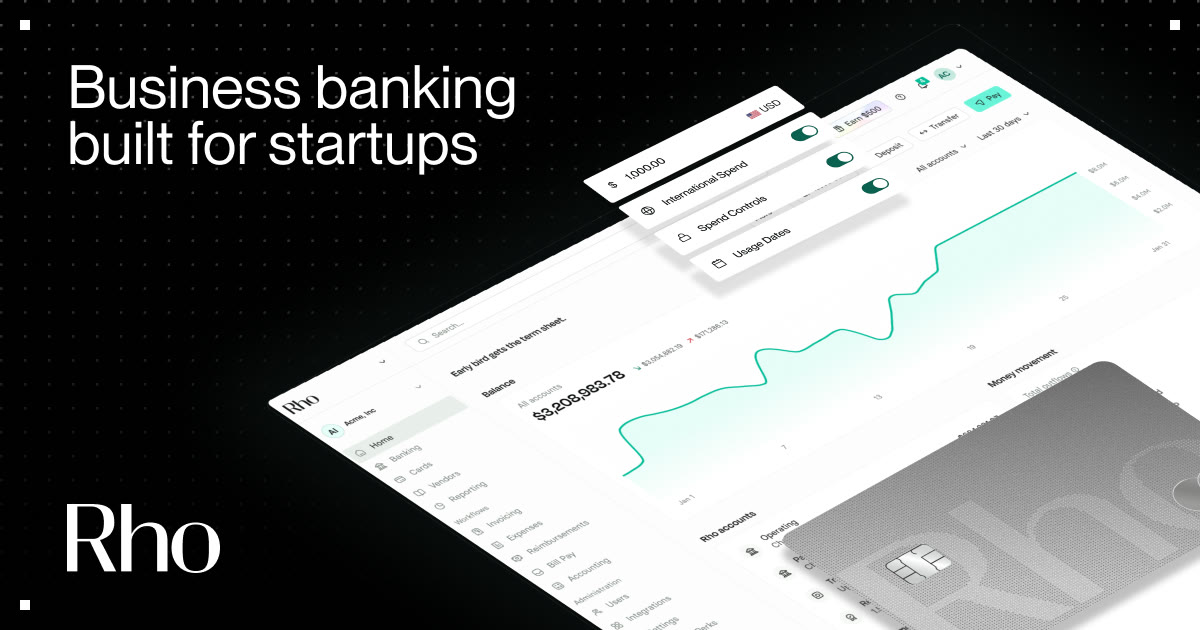
Rho pairs business banking with a corporate card, expense management and bill pay. Its fee table lists $0 subscription fees, $0 per-user fees and $0 for AP, expense and accounting automation [9].
Verified features: Rho offers Mastercard World Elite Business cards to US-incorporated businesses with an EIN, with no personal guarantee, and says it will not run a hard or soft check on your credit score [10].
Pricing: No subscription or per-user fees. Foreign currency transfer and conversion carries a 1% fee [9].
Strengths: On Daily Terms, cashback is up to 1.25% standard and up to 2% with Rho Platinum, on up to $1M in eligible annual card spend [10]. Cash back is simpler to compare than points.
Limitations: Platinum applies only when payroll is funded from Rho, revenue is deposited via Rho, and 50% or more of company assets are held at Rho [10]. The pages we read do not mention travel booking.
Best fit: Founders willing to move their main banking to Rho in exchange for higher cashback and free bill pay.
Expensify — for teams that mainly need expense reports

Expensify is an expense tool first, with a card, travel booking and bill pay added [13]. It suits teams whose main problem is receipts and reimbursements.
Verified features: Collect includes reimbursements, corporate card management, travel booking and rules, and QuickBooks/Xero integrations [11]. You can link the cards you already have, and Expensify lists 45+ integrations [13].
Pricing: Submit is free for individuals, Collect is $5 per member per month, and Control has custom pricing "as low as $9/member/month" [11].
Strengths: The Expensify Card has "No platform fees, deposits, personal guarantees, or credit checks" and no foreign transaction fees [11].
Limitations: It charges per member, while Brex Essentials is $0 per user [2]. The card pays 1% cash back on US purchases and 2% only for monthly spend over $250K [11]. NetSuite and Sage Intacct sync need the Control plan [11].
Best fit: Small teams that care most about receipt scanning and reimbursements, or that want to keep their current corporate card.
How to choose among Brex competitors
Start with the job Brex does for you today. If you use its card, expenses, bill pay and travel together, Ramp is the only option here that lists all four on a free plan [1]. If travel is most of your spend, Navan is built around booking. If you only use Brex for expense reports, Expensify or Navan Expense may be enough.
Next, decide where your cash should live. Mercury and Rho are banking products with cards attached, so switching means moving your operating account. BILL, Ramp, Navan and Expensify work alongside the bank you already have.
Then count the per-seat costs. Navan charges $15 per expense user after five [4], Expensify charges $5 per member [11], and BILL charges for its payables plans [6]. Brex pricing starts at $0, with $12 per user for Premium [2]; a 20-person team on Premium pays $240 a month.
Finally, check accounting. Most of these products name QuickBooks Online and Xero. NetSuite support is on Ramp Plus and Expensify Control [1] [11]. If card data needs to reach a CRM or an internal tool, our fintech app development team builds those links. For a card-by-card view, see our guide to the best corporate cards for small businesses, and for tools that work with any card, our roundup of expense management software.
FAQ
What is the best Brex alternative for a small business?
For a free plan that covers the same ground, Ramp includes a corporate card, bill pay, travel booking and QuickBooks Online and Xero integrations at $0 per user [1]. Navan and Expensify are narrower fits for travel and expense reporting.
Ramp vs Brex: which is cheaper?
Both start at $0 per user per month [1] [2]. Brex Premium is $12 per user per month, while Ramp Plus is $15 per user per month plus a platform fee based on team size [2] [1].
Brex vs Mercury: what is the difference?
Mercury is a banking platform whose $0 plan includes cards, expense management and bill pay, with 1.5% cashback on credit card spend [7] [8]. Brex includes travel booking on Essentials [2], which Mercury's pages do not list.
Which Brex alternatives skip the personal credit check?
Mercury, Rho and the Expensify Card all say they do not run credit checks or require personal guarantees [8] [10] [11]. Rho requires US incorporation and an EIN [10].
Our recommendation
Start with Ramp if you want to replace Brex as a whole with no per-user fee. Choose Navan if travel drives your spend, BILL Spend & Expense if your payables already run through BILL, and Mercury or Rho if you are happy to move banking along with cards. Expensify is the pick for teams that mainly want easier expense reports. Before you switch, list the integrations and approval rules you rely on in Brex today and confirm each one on the new plan. If you also need spend data in your sales system, see our custom CRM development work.
Sources
- Ramp Pricing and Plans — checked 2026-11-24
- Brex Pricing Plans - Get Started Today — checked 2026-11-24
- The Best Corporate Card for Startups and Growing Businesses — checked 2026-11-24
- Navan Pricing: Your Travel & Expense Management Simplified — checked 2026-11-24
- Expense Management Software Without the Busywork - Navan — checked 2026-11-24
- Pricing & Plans - BILL — checked 2026-11-24
- Explore Pricing - Mercury — checked 2026-11-24
- Online Business Banking For Startups, Small Businesses & Scaling Companies — checked 2026-11-24
- Rho Pricing - Simple, Transparent Business Banking — checked 2026-11-24
- Corporate Credit Card for Startups - Up to 2% Cashback with Rho Platinum (terms apply) - Rho — checked 2026-11-24
- Expensify - Pricing — checked 2026-11-24
- Expense Management Software - BILL Spend & Expense — checked 2026-11-24
- Spend Management Software for Receipts & Expenses - Expensify — checked 2026-11-24