SFDIFY

For a small or mid-size finance team that already lives in spreadsheets, the strongest FP&A software options are Datarails and Vena, both built around Excel [1] [2], and Cube, which works natively in Excel and Google Sheets and includes unlimited users on every plan [3]. Planful, Pigment and Abacum are platform-style alternatives that center planning in their own apps, with AI assistants built in [4] [5] [6]. None of the six publishes a list price on the pages we checked; Datarails, Cube and Vena describe plan tiers but price by quote [7] [3] [8].
Disclosure: Datarails is an SFDIFY partner, and we earn a commission if you buy through our link. It appears first for that reason, not because it scored higher, and its weaknesses are listed below like everyone else's.
How we chose
We compared six financial planning and analysis tools that small and mid-size finance teams commonly shortlist: Datarails, Cube, Vena, Planful, Pigment and Abacum. For each one we read the official homepage and, where one exists, the public pricing page, on November 12, 2026. We looked at four things: how the tool fits with Excel, what each plan includes, how the vendor limits users or entities, and how much of the pricing is public. We did not run hands-on tests, and there are no scores here. Everything below is based on what the vendors publish, so treat it as a starting shortlist and confirm details in a demo.
FP&A software compared
| Product | Best for | Starting price | Notable |
|---|---|---|---|
| Datarails | Excel-first teams that also want close, cash and spend tools | Custom quote; entry Professional plan includes 2 users and 1 integration [7] | Connects to "600+ sources" [1] |
| Cube | Teams that want Excel or Google Sheets plus unlimited users | Custom quote; Bronze plan covers 1 legal entity [3] | "Unlimited users, unlimited dimensions, and unlimited dashboards" on every plan [3] |
| Vena | Microsoft 365 shops with heavier close and consolidation needs | Quote-based Professional and Complete plans [8] | Licenses split into Power User, Contributor and View Only [8] |
| Planful | Teams that want planning, close and consolidation in one app | Not listed on the pages we checked | "Trusted by 1500+ companies" [4] |
| Pigment | Larger, fast-growing companies planning across many departments | Not listed on the pages we checked | Positions itself for "enterprise business planning" [5] |
| Abacum | Startup and scale-up finance teams that want an AI-led planning app | Not listed on the pages we checked | Built around an agent called Abra [6] |
Datarails — the Excel-first pick with a growing suite

Datarails describes FinanceOS as "the governed, Excel-connected operating layer for finance," and its pitch to finance teams is simple: "Keep the Excel models you trust while fixing the chaos of disconnected data" [1]. The company says "Finance teams at 2000+ companies run on Datarails" [1].
Verified features: Datarails links reporting and planning "to live data from 600+ sources" and adds "version control, audit trails, permission settings, centralized business logic" [1]. Beyond FP&A, the suite includes Month-End Close, Cash, Spend and Desk products [1]. Every plan includes "Datarails AI Agents" and the "FinanceOS AI Connector" [7].
Pricing: Datarails does not publish dollar figures. Its pricing page says "Get a custom quote tailored to your needs" and promises "no consultant fees—ever" [7]. The tiers are Professional (2 users, 1 integration), Premium (5 users, 2 integrations) and Expert (15 users plus 50 viewers, 3 integrations) [7]. We cover what those tiers tend to cost and how quotes work in our Datarails pricing guide.
Strengths: If your models already run in Excel, Datarails asks the least change of your team. The tiered suite also means a growing company can add close and cash work later without switching vendors.
Limitations: Seats and integrations are capped by tier, and the entry plan allows only 2 users and 1 integration [7]. That is tight for a team that pulls from an ERP, a CRM and a payroll system. Cash Management and Month-End Close are bundled only in the top Expert plan; on lower plans they are modules you "layer onto" the plan [7], which adds cost. Cube, by comparison, does not cap users on any plan [3]. There is no public price, so you cannot budget without a sales call.
Best fit: A small finance team, often two to five people, with Excel models it does not want to rebuild and a short list of data sources.
Cube — spreadsheet-native with no user caps
Cube calls itself an agentic FP&A platform, and its homepage says "Four FP&Agents handle the always-on work across your data, reports, plans and business partners" [9].
Verified features: Every plan includes the web workspace and "Excel & Google Sheets, native" access [3]. Cube says AI agents "for data, analysis, planning, and reporting are included in every plan" [3]. Silver and Gold add Slack, Teams, PowerPoint and Google Slides, plus workflows and SSO [3].
Pricing: Cube is "priced by plan, quoted for your company" [3]. The tiers are scaled by legal entities: Bronze covers 1 entity, Silver up to 10 and Gold up to 50 [3]. Multicurrency consolidation is included on Gold and is an add-on on lower plans [3].
Strengths: Unlimited users on every plan [3] is the clearest difference from Datarails, and Google Sheets support helps teams that never standardized on Excel.
Limitations: Pricing is still quote-only [3]. A multi-entity company that needs currency translation has to look at Gold or pay for the add-on [3], and collaboration surfaces such as Slack and Teams are not in Bronze [3].
Best fit: A lean finance team that wants department heads in the system without paying per seat.
Vena — Excel-native planning for Microsoft 365 shops

Vena builds its planning around Excel, saying teams can "model unlimited "what-if" scenarios and easily make bottom-up or top-down adjustments—all within Excel" [2].
Verified features: Vena connects ERP, CRM and HRIS data to "Vena CubeFLEX—our OLAP database built specifically for Excel" [2]. On the close side it covers "consolidations and account reconciliations to tax provisioning" [2]. AI agents surface insights "in Microsoft Teams and Excel Live" [8].
Pricing: Vena lists two plans, Professional and Complete, without dollar amounts [8]. Complete adds Vena Insights, Premium Support, a Sandbox Environment and Expert Managed Services [8]. Licensing is split into Power User, Contributor and View Only roles [8]. Vena notes that "Export APIs are available for an additional fee" [8].
Strengths: Deep Microsoft fit and a broad set of close and consolidation use cases in one vendor.
Limitations: Useful extras such as the sandbox and managed services are reserved for the Complete plan [8], and export APIs cost extra [8]. Teams on Google Workspace get less from the Microsoft-centered design.
Best fit: Mid-size companies standardized on Microsoft 365 with growing close and reporting requirements.
Planful — one platform for planning, close and consolidation
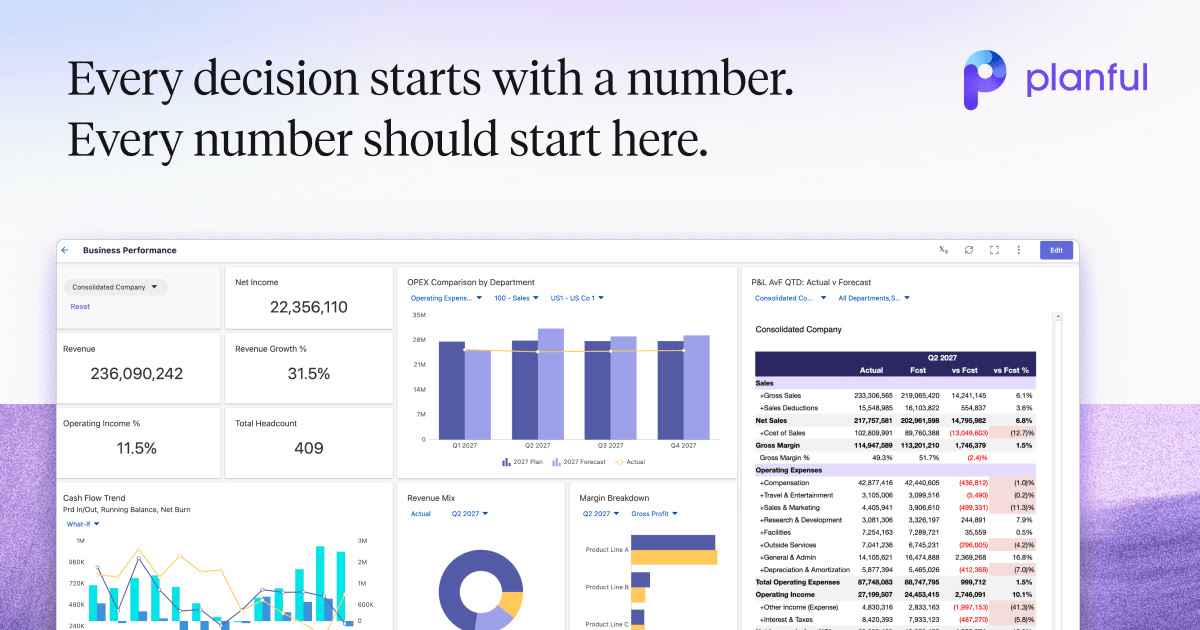
Planful says it "connects planning, close, consolidation, and reporting in one financial performance management platform" [4].
Verified features: Planful AI includes agentic assistants named Analyst, Help and Planner [4]. Its MCP Server lets teams "Ask questions in Claude and get answers built on your Planful data," and it is "Read-only by design" [4]. Planful also offers planning tools for sales, marketing, HR, IT and operations teams [4].
Pricing: We could not find a public pricing page; planful.com/pricing returned a not-found page on November 12, 2026. Expect a quote.
Strengths: Close and consolidation live alongside planning, which helps controllers as much as FP&A analysts.
Limitations: No published pricing or plan breakdown. Planning centers on Planful's own platform rather than on the Excel models your team already has, so expect more change management than with Excel-first tools; ask in a demo how spreadsheet access works.
Best fit: Mid-size companies with several entities that want close and planning in a single system.
Pigment — flexible modeling for fast-growing companies
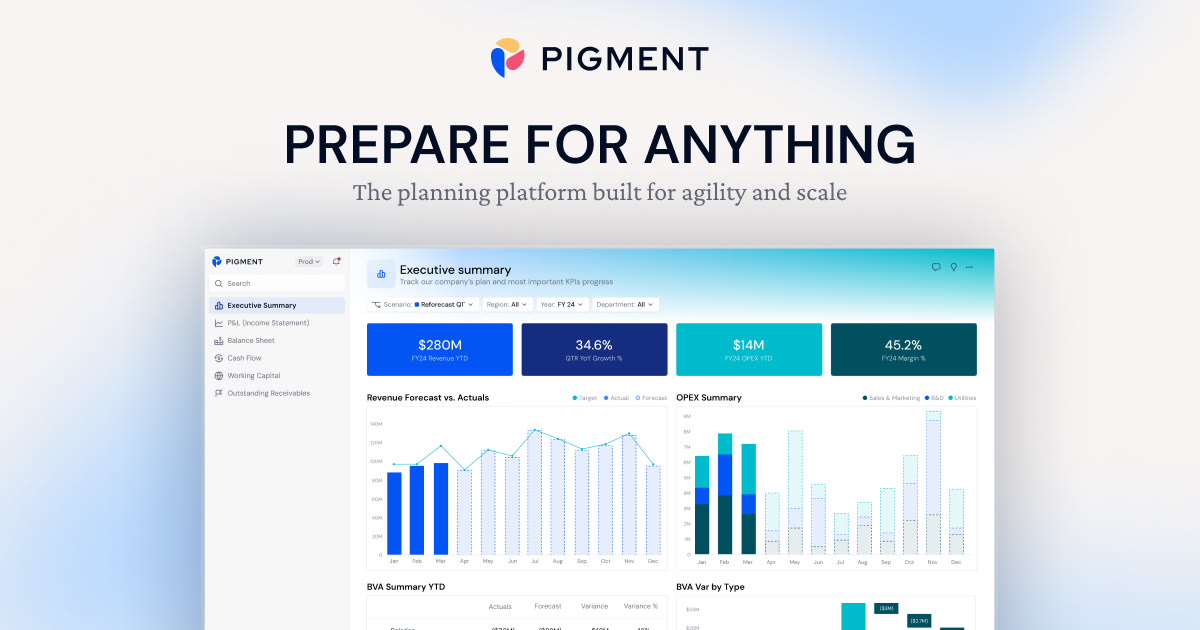
Pigment describes itself as "the AI platform built for real-time business planning" and positions its product as "Agentic AI for enterprise business planning" [5].
Verified features: Pigment covers budget planning and forecasting, P&L, cash flow and balance sheet planning, sales and operations planning, and territory and quota planning [5]. With its Modeler capability, you "Describe what you want to build in natural language" and Pigment builds the model [5].
Pricing: Pigment did not have a public pricing page we could load on November 12, 2026.
Strengths: Strong cross-department planning, so finance, sales and HR work from one model.
Limitations: The enterprise positioning [5] suggests it may be more platform than a small team needs, and without public pricing you cannot gauge cost in advance.
Best fit: Venture-backed or fast-scaling companies with several departments planning together.
Abacum — an AI-led planning app for scale-ups
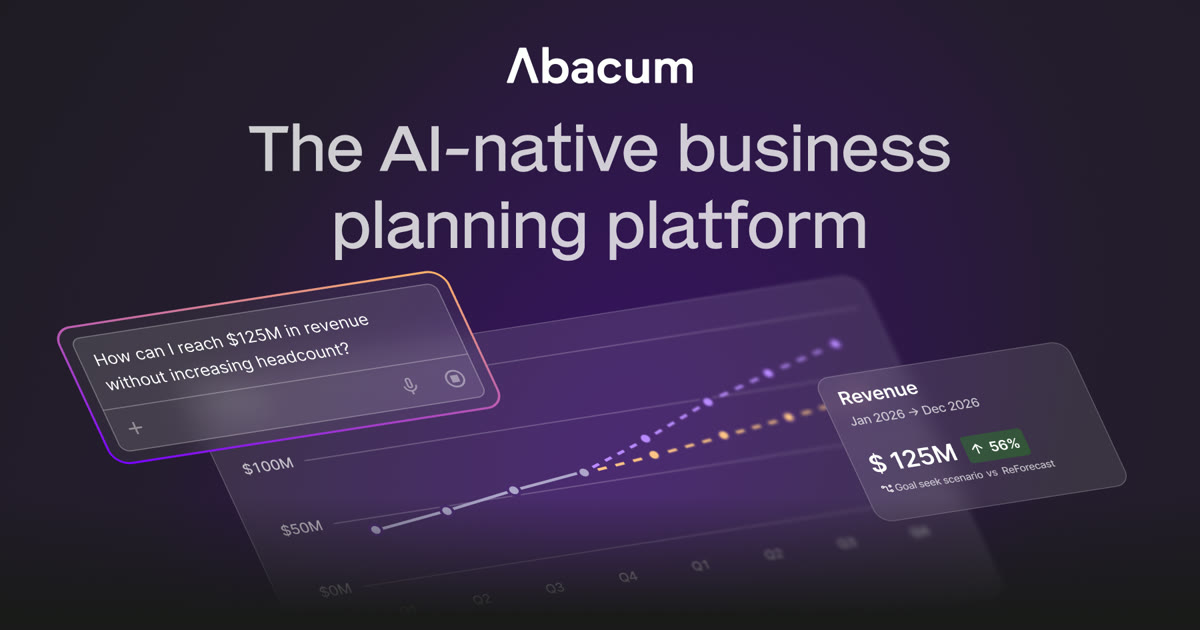
Abacum calls itself "The AI-native business planning platform" [6].
Verified features: Abacum is built around Abra, "the agent that already knows your business," which can answer questions, build models and draft board packs [6]. Abacum says you can evolve models "without a support ticket or a consultant contract" [6]. It also offers investor updates and real-time multi-entity consolidation [6].
Pricing: We found no public pricing page; abacum.ai/pricing redirected to the homepage on November 12, 2026.
Strengths: Investor reporting and headcount planning fit startup finance work well.
Limitations: There is no public pricing, the product centers on its own planning app rather than your existing Excel models, and custom Abra agents are still listed as "Coming soon" [6].
Best fit: Startup and scale-up finance teams that report to investors and want AI built into planning.
How to choose the best FP&A software for your team
Start with where your models live. If your analysts will not give up Excel, the shortlist is Datarails, Vena and Cube. If Google Sheets matters, note that Cube lists native Excel and Google Sheets access on every plan [3].
Next, count people and data sources. Per-tier caps on users and integrations [7] matter more for a team of eight than for a team of two. If you want every department head entering numbers, unlimited users [3] or view-only licenses [8] can change the cost picture.
Then check entity count. Cube prices by legal entity [3], so a company with a dozen subsidiaries lands on a higher tier quickly.
Finally, ask every vendor for a written quote that includes implementation and support. All six price by quote or do not publish prices, so get two or three quotes before you decide. If your stack needs a custom bridge between finance tools and the rest of your systems, our fintech app development team builds those integrations, and our guide to custom software vs off-the-shelf helps you decide when buying is the better call.
FAQ
What is the best FP&A software for small business?
For a small team that works in Excel, Datarails and Cube are the closest fits. Datarails keeps your Excel models [1] but caps its entry plan at 2 users [7], while Cube includes unlimited users on every plan [3].
How much does FP&A software cost?
None of the six vendors here publishes list prices. Datarails, Cube and Vena quote each customer [7] [3] [8], and their tiers scale by users, integrations or legal entities [7] [3]. See our Datarails pricing breakdown for an example of how quotes are structured.
Which FP&A tools work inside Excel?
Datarails is "Excel-connected" [1], Vena runs modeling "all within Excel" [2], and Cube includes native Excel and Google Sheets access on every plan [3].
Do FP&A software tools include AI?
Yes. Datarails includes AI agents on every plan [7], Cube includes AI agents on every plan [3], and Planful offers Analyst, Help and Planner assistants [4].
Our recommendation
If your finance team is small and Excel-bound, start with Datarails, but price out the user and integration caps first [7]. If you need more seats than Datarails' entry tiers allow, get a Cube quote, since every Cube plan has unlimited users [3]. Microsoft-heavy mid-size teams should add Vena to the shortlist, and companies planning across many departments should look at Pigment or Planful.
Sources
- Datarails FinanceOS: Trusted AI for Finance Teams — checked 2026-11-12
- Vena: The #1 Microsoft-Native Financial and Operational Planning Platform — checked 2026-11-12
- Transparent and Upfront Pricing | Cube FP&A Software — checked 2026-11-12
- Drive Financial Performance with Planful — checked 2026-11-12
- Agentic AI for enterprise business planning | Pigment — checked 2026-11-12
- Abacum | The AI-native business planning platform — checked 2026-11-12
- Pricing - Datarails — checked 2026-11-12
- Pricing Plans & Features | Vena Solutions — checked 2026-11-12
- Agentic FP&A Platform | Cube — checked 2026-11-12