SFDIFY

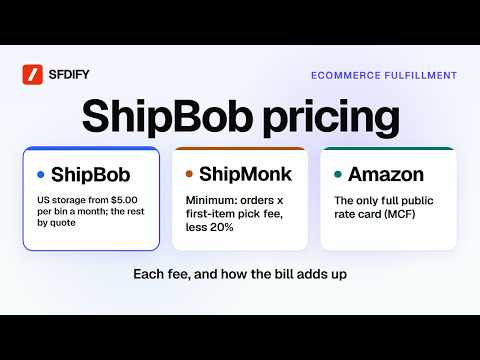
ShipBob has no public rate card. Its pricing page names four standard charges (implementation, receiving, warehousing, and pick, pack and ship) and says "All quotes are customized for each customer" [1]. The figures ShipBob does print are US storage at $5.00 per bin, $10.00 per shelf and $40.00 per pallet per month, prorated daily [2], and software that is "completely free for all customers" [1]. Of the alternatives below, only Amazon Multi-Channel Fulfillment publishes a full per-order rate card [3].
More comparisons on our YouTube channel: @sfdify_ai
How we chose
We set ShipBob's published pricing beside four warehouse fulfillment services a small brand is likely to get quotes from: ShipMonk, Amazon Multi-Channel Fulfillment (MCF), LVK (the fulfillment network that runs on ShipHero) and Red Stag Fulfillment. Everything here comes from the vendors' own pricing pages, FAQs and rate cards, read on November 25, 2026. We did not open accounts or request quotes, so treat any dollar figure as a published list number, not what you will be offered. If you want the broader feature comparison first, our roundup of fulfillment services for small brands covers that; this page sticks to cost.
ShipBob pricing next to four alternatives
| Service | Best for | Starting price | Notable |
|---|---|---|---|
| ShipBob | DTC brands that want one network and free software | Custom quote; US storage from $5.00 per bin per month [2] | Storage billed twice a month, prorated to the day [4] |
| ShipMonk | Brands that want the minimum spelled out | Custom quote [5] | Monthly minimum = monthly orders x first-item pick fee, less 20% [5] |
| Amazon MCF | Amazon sellers adding other channels | $7.53 for one small standard unit up to 4 oz, peak standard rate [3] | Full public rate card [6] |
| LVK (ShipHero) | Brands that want no setup fee | Custom plan [7] | No onboarding or setup charge [7] |
| Red Stag Fulfillment | Big, heavy products | Custom quote only [8] | No standard rate card published [8] |
ShipBob — quote-based, with a few printed numbers
ShipBob stores your inventory, packs each order and ships it from a network it describes as "50+ fulfillment centers" [9]. Storage is the only fee line ShipBob prices on its own site before you talk to sales.
Verified features: ShipBob ships to "250+ destinations" [9]. Standard packaging is free: plain brown boxes, poly mailers, bubble mailers, dunnage and labels [1]. You can use your own branded boxes and inserts; "All you do is pay to store them" [1].
Pricing: Here is each fee line as ShipBob describes it.
- Implementation: listed as a standard fee on the pricing page, with no amount given [1].
- Receiving: ShipBob says receiving "is typically charged per hour rather than per unit" [2]. The same page shows a sample 3PL table with $35 for the first two hours and $45 per hour after, then adds that the table "is not necessarily reflective of ShipBob's service pricing" [2]. Treat it as a rough guide.
- Storage: $5.00 per bin, $10.00 per shelf and $40.00 per pallet per month in the US [2]. Storage is billed on the 15th and the last day of each month and prorated to the day [4]. Each SKU gets its own bin, shelf or pallet location [4].
- Pick, pack and ship: one all-in cost per B2C order that covers picking and packing labor, plain packaging and the shipping label [2]. Additional units add per-item charges on top of a base fee [2].
- Shipping: varies with weight, dimensions, destination and service, and each quote is customized [1].
- Add-ons: returns carry a flat fee per return [1]; kitting, B2B and wholesale work are available "at an additional cost" [1].
- Software: free, including turnkey integrations [1].
Strengths: Storage is the one fee you can model before a call, and daily proration means a SKU that sells out mid-month stops costing you right away [4]. Free software keeps a platform fee off the bill [1].
Limitations: You can't estimate your per-order cost from ShipBob's site, because pick, pack, shipping, receiving and implementation all come back in a quote [1]. ShipBob also says it is "primarily partnering with larger, higher-volume brands" now [4], which a store shipping a few hundred orders a month should weigh. One storage location per SKU means a wide catalog of slow sellers can run up bin fees quickly.
Best fit: A US-focused DTC brand with steady volume and a modest SKU count that wants one dashboard and is fine getting its real per-order price from a sales call. Get that quote in writing.
ShipMonk — a published formula for the monthly minimum
ShipMonk is the closest like-for-like quote to get next to ShipBob, and its pricing page explains more of the bill in writing.
Verified features: ShipMonk's pricing page groups costs into storage, fulfillment fees, special projects and shipping [5]. It ships to "200+ countries" [5].
Pricing: All rates come from a quote, but the page states how the monthly minimum works: ShipMonk multiplies "your monthly order volume by your first item pick fee and then reducing it by 20%" [5]. As a hypothetical, a brand quoted $3.00 per first pick at 500 orders a month would have a $1,200 minimum. Your quote also lists "platform, onboarding, and any add-on technology fees" [5], so software is not automatically free here. Custom packaging is billed as an additional item at pick and pack, and subscription batches under 50 orders carry a batching fee [5].
Strengths: You can work out your minimum the moment you see the pick fee, which ShipBob's pages don't let you do. Returns are priced per carton and per additional item [5].
Limitations: No dollar amounts are published. Platform and onboarding fees can appear on the quote, which removes one of ShipBob's clearer advantages.
Best fit: Brands that want the minimum-spend math in writing before they sign, and those comparing ShipBob vs ShipMonk on the same order profile.
Amazon Multi-Channel Fulfillment — the only full public rate card

Amazon Multi-Channel Fulfillment ships orders from your website, other marketplaces and social channels out of "a single pool of inventory" in Amazon's network [10].
Verified features: Orders go out in unbranded packaging by default [10]. Fees are based on "product size, shipping weight, units per order, and delivery speed" [6].
Pricing: The current rate card covers October 15, 2026 to January 14, 2027 and lists peak fees that include pick, pack and ship [3]. At standard speed, one small standard unit of 4 oz or less costs $7.53 per order, and one large standard unit of 1 to 2 lbs costs $10.97 [3]. Multi-unit orders cost less per unit: the same 4 oz small standard item drops to $3.83 per unit on orders of four or more [3]. Storage for standard-size, non-dangerous goods is $0.78 per cubic foot from January to September and $2.40 from October to December [3]. Amazon says US standard-speed fees will rise "by an average of 3.5%" in 2027 [6].
Strengths: You can price a full order before you talk to anyone, which none of the 3PLs here allow.
Limitations: Packaging is unbranded by default [10]. Storage costs roughly three times as much per cubic foot from October to December [3], and orders to Alaska, Hawaii and other non-contiguous areas carry a 100% surcharge for standard-size items [3].
Best fit: Sellers already using FBA who want website, marketplace and social orders shipped from the same stock.
LVK (ShipHero fulfillment) — no setup or onboarding fee
LVK is the fulfillment network that "runs on ShipHero," the warehouse software [11].
Verified features: LVK owns and operates 6 fulfillment centers, including sites in Pennsylvania, Nevada, Texas, Florida and Canada [7].
Pricing: LVK "does not charge for onboarding" and "does not charge for setup" [7]. Its flat rate includes one pick per shipment, with extra picks charged per pick [7]. Storage is priced on "the space you use each day" through a custom plan [7]. Possible extra fees include a fuel surcharge, DIM weight, hazardous materials, signature and overweight pick charges [7].
Strengths: It is the only service here that states in writing there is no setup or onboarding fee, which matters if ShipBob's quote includes an implementation charge.
Limitations: No per-order or storage figures are published, and the list of possible surcharges is long.
Best fit: Brands with apparel, CPG or electronics inventory that want a smaller network and no upfront fee.
Red Stag Fulfillment — custom quotes for big and heavy goods
Red Stag Fulfillment targets products "bigger than a toaster or heavier than 10 pounds" [12].
Verified features: Red Stag runs a flagship facility in Sweetwater, TN and a western location in Salt Lake City [12].
Pricing: The pricing page says it is "entirely custom" and that Red Stag does not publish "a standard rate card for receiving, storage, or order fulfillment" [8].
Strengths: It says it negotiates hardest on Additional Handling and Oversize surcharges [12], which is where heavy items lose margin.
Limitations: Nothing on the page lets you estimate a bill.
Best fit: Furniture, fitness and other bulky products where carrier surcharges outweigh pick fees.
How a monthly 3PL bill adds up
Any of these 3PL fulfillment services bills you in the same five layers, so compare quotes line by line:
- One-time costs. Ask ShipBob what its implementation fee is [1] and ShipMonk what its onboarding and platform fees are [5]. LVK says it charges neither [7].
- Receiving. ShipBob bills receiving by the hour [2]. Send fewer, larger, well-labeled inbound shipments.
- Storage. At ShipBob, 40 SKUs in one bin each would run $200 a month at $5.00 per bin [2]. Count your SKUs, not your units.
- Per-order fulfillment and shipping. This is usually the largest line and the one ShipBob, ShipMonk and Red Stag only give in a quote. Amazon's rate card is the only public benchmark here [3].
- Minimums and add-ons. ShipMonk's minimum is formula-based [5]; returns, kitting and custom packaging cost extra at ShipBob and ShipMonk [1, 5].
Ask each vendor for a sample invoice at your volume. If you would rather keep shipping in-house for now, our ecommerce shipping software comparison covers label and rate tools. If you plan to pipe order and cost data into your own systems, our custom CRM development team builds those connections.
FAQ
How much does ShipBob cost per month?
ShipBob does not publish a monthly total. Storage in the US is $5.00 per bin, $10.00 per shelf and $40.00 per pallet per month, prorated daily [2]. Receiving, pick and pack, shipping and implementation come in a custom quote [1].
Does ShipBob charge for its software?
No. ShipBob says its software is "completely free for all customers," including turnkey integrations [1].
What is the ShipBob cost compared with ShipMonk?
Neither publishes per-order rates. ShipMonk explains that its monthly minimum is monthly orders multiplied by the first-item pick fee, minus 20% [5], and its quote can include platform and onboarding fees [5]. ShipBob's software is free [1], but its pricing page does not describe a minimum.
Which order fulfillment service publishes its prices?
Of the five here, Amazon Multi-Channel Fulfillment is the only one with a downloadable rate card, starting at $7.53 for a single small standard unit at peak standard speed [3]. Red Stag says it does not publish a standard rate card [8].
Our recommendation
Get a ShipBob quote if you want free software and a large network, and ask in writing for the implementation fee, the per-order all-in cost at your volume and any minimum. Get a ShipMonk quote at the same order profile so you can check its minimum formula against ShipBob's numbers. If you already sell on Amazon, price a typical order on the MCF rate card first; it sets a public baseline. Heavy goods belong with a Red Stag quote, and LVK is worth a call if you want to avoid setup fees.
Sources
- ShipBob Pricing: ShipBob's Outsourced Fulfillment Service Costs — checked 2026-11-25
- Fulfillment Costs 101: How to Calculate & Reduce Fulfillment Costs — checked 2026-11-25
- Multichannel Fulfillment fees rate card - Amazon Supply Chain Services — checked 2026-11-25
- How ShipBob Optimizes Storage Costs for Fast-Moving Inventory — checked 2026-11-25
- 3PL Fulfillment Pricing for D2C Brands - ShipMonk — checked 2026-11-25
- Fulfillment and storage fees in Amazon fulfillment centers - Amazon Supply Chain Services (ASCS) — checked 2026-11-25
- Locations, Pricing, and Support - LVK Fulfillment FAQs - LVK — checked 2026-11-25
- Red Stag Fulfillment Pricing - 3PL & Warehousing Services — checked 2026-11-25
- Global Ecommerce Fulfillment Solution - ShipBob — checked 2026-11-25
- Multichannel Fulfillment (MCF) - Amazon Supply Chain Services (ASCS) — checked 2026-11-25
- LVK - LVK Logistics — checked 2026-11-25
- Red Stag Fulfillment - A 3PL Ecommerce Fulfillment Company — checked 2026-11-25