 SFDIFY
- Write down what "success" looks like for the AI feature in one sentence.
- List every edge case you can think of — what happens when the model is wrong or unsure.
- Check whether your team can review AI output technically, not just for "does it sound right."
Hiring individual AI developers gets you headcount. Bringing in a studio gets you a team that has already shipped AI to production and made the mistakes on someone else's project instead of yours. We do both kinds of work at SFDIFY, and the honest answer is that the right choice depends on whether you already know exactly what you're building.
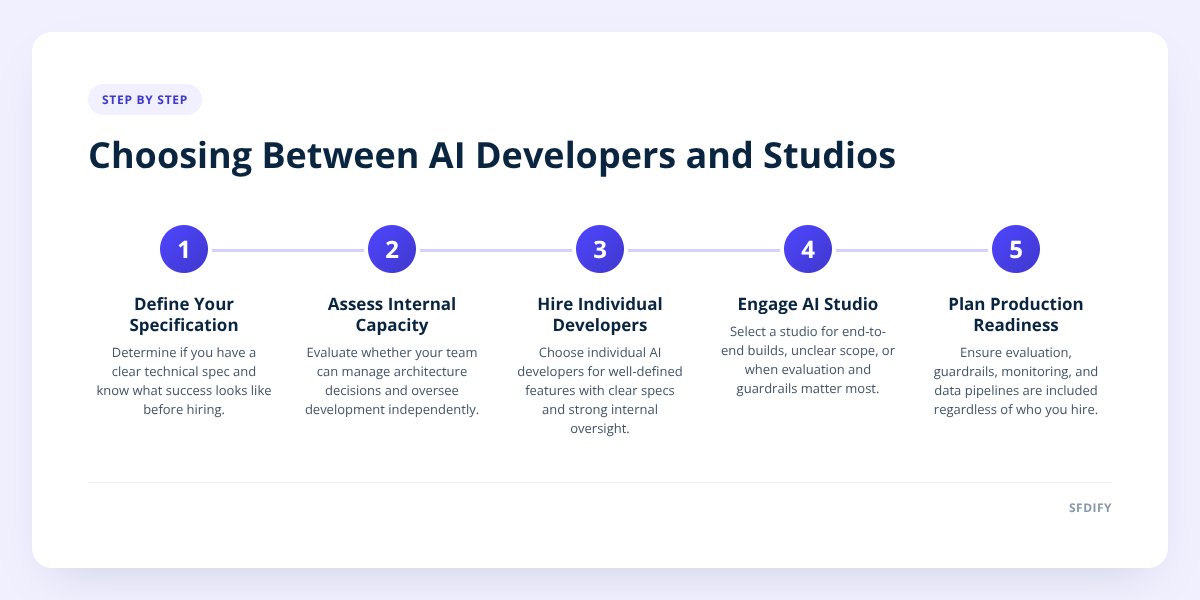
hire individual AI developers when you have a clear technical spec, an in-house team that can manage them, and time to onboard. Bring in an AI studio when you need the whole path from idea to production — architecture, evaluation, guardrails, deployment — and you want people who have already done it more than once. Most founders underestimate how much of an AI project is the non-model work: data pipelines, testing for hallucinations, monitoring, and the plumbing that connects a model to an actual product.
- A solo AI developer or small contractor team is usually cheaper per hour but carries all delivery risk on your side — you own the architecture decisions and the debugging.
- An AI studio bills for outcomes and has a track record of moving a model from a demo into something users depend on, including the evaluation and guardrail work that demos skip.
- The riskiest AI projects are the ones that never define what "working" means before development starts — that step matters more than who you hire.
- Cost comparisons that only look at hourly rate miss the cost of a stalled project, which is common when a single hire discovers mid-build that the scope needed a team.
1. What does hiring an individual AI developer actually get you?
It gets you a pair of hands, not a finished system. A skilled AI developer can write the code that calls a model, build a retrieval pipeline, or fine-tune something — but someone still has to decide what "good" looks like, how to test for failure, and who monitors it once it's live.
This works well when you already have that thinking done. If your team has a product manager who can write a tight spec, an engineer who understands your existing stack, and a plan for who reviews the AI's output before it ships, one or two strong hires can execute against that plan efficiently.
It works poorly when the hire is expected to also be the strategist. We see this most often with a first AI feature: a company hires an "AI developer" and then discovers three months in that nobody defined how the chatbot should behave when it doesn't know the answer, or how to measure whether it's actually helping. That's not a coding problem. It's a product problem, and most individual hires aren't scoped or paid to solve it.
if you can write the full spec yourself, hire a developer; if you can only describe the problem, hire a team that has shipped the solution before.
2. What does an AI studio deliver that a hire doesn't?
An AI studio delivers a system that has already been through the failure modes, because the team has hit them on other builds. That's the real difference — not more people, but people who know what breaks.
Take evaluation and guardrails, which is the part of AI development that rarely shows up in a job posting for an "AI developer" but decides whether a product is trustworthy. When we build AI products through our AI development work, that includes setting up how we measure whether the model's answers are accurate, what happens when it's uncertain, and how we catch drift after launch. A single hire can build this, but only if someone tells them to and gives them time — a studio builds it in by default because a past project taught them what happens when it's skipped.
Our own products are proof this isn't theoretical. MyCheck lets users save checklists directly from ChatGPT, Claude, Grok, or Gemini — a feature that only works reliably because someone tested how each model formats output and built for the differences, not just the happy path. That kind of edge-case handling is what separates a demo from a production feature.
| Individual AI developer(s) | AI studio | |
|---|---|---|
| Best for | Well-defined feature with an existing spec | End-to-end product, unclear scope, first AI build |
| Who owns architecture decisions | You or your in-house lead | The studio, informed by prior production work |
| Speed to a working demo | Can be fast | Can be fast |
| Speed to something safe in production | Depends heavily on your team's AI experience | Faster on average — evaluation and guardrails are built in |
| Cost structure | Lower hourly rate, open-ended hours | Project or milestone-based, scoped upfront |
| Risk if scope was wrong | Falls entirely on you | Shared — a studio has to re-scope, not you alone |
Our recommendation: if you're staffing a known feature inside a product your team already runs, hire developers directly — you have the context to manage them well. If you're building your first AI product, or the thing you're building needs to be trustworthy on day one (customer-facing, handling sensitive data, tied to revenue), an AI studio is the safer bet, because the cost of a wrong architecture decision is much higher than the difference in hourly rate.
3. How do you tell which one your project actually needs?
Ask whether you could hand someone a finished spec today. If yes, you likely need developers. If you'd struggle to answer basic questions about how the AI should behave when it's wrong, you need a studio — or at minimum, an AI consulting engagement before you hire anyone.
We wrote about this decision point in more detail in How to Tell Which Business Processes AI Can Automate, because the honest first step is often not "who builds this" but "should this be built at all, and what does success look like." A lot of AI projects fail not because the code was bad but because nobody defined the target before writing it.
A quick gut check:
- If you can describe the exact inputs and outputs of the feature, and your team can review the AI's work, hire developers.
- If you're not sure whether you need a chatbot, an agent, or something simpler, get AI consulting before hiring anyone.
- If the project touches customer data, money, or compliance, weight toward a studio — the guardrail work is not optional there.
- If you need a working prototype to show investors or a first customer, an MVP-focused build is different from either option above; we cover that in How to Build an AI MVP That Actually Attracts Investors.
4. What does "shipped to production" actually mean, and why does it matter?
It means the system runs unattended, with monitoring, for real users — not that it worked in a demo. This distinction is the single biggest gap between a portfolio of side projects and a studio's track record.
Yolda, our AI-native transportation management system, reads rate confirmation documents and automatically creates loads, then separately watches CDL, medical card, and insurance expiration dates for carriers across the Midwest. Both of those are the kind of feature that looks simple in a pitch deck and is genuinely hard in production: documents come in inconsistent formats, dates need to trigger real alerts before they lapse, and a missed one has real consequences for a trucking company's compliance. Building that reliably took the same evaluation discipline as building a chatbot — testing against edge cases, not just the clean example.
Demo:     model reads 1 clean sample document correctly
Prod:     model reads 500 documents/day, formats vary,
          fields missing 12% of the time — that 12% needs
          a fallback, a flag, or a human review step
A team that has only ever shipped demos hasn't had to solve the second scenario. That's not a knock on individual developers — it's the nature of the work. Production discipline gets built by repetition, and it's fair to ask any hire or studio directly how many of their AI builds are still running, unattended, today.
5. How does this shape the way we build AI for clients?
We treat every AI feature as a production system from day one, not a demo that gets hardened later. That means evaluation criteria and guardrails get designed alongside the feature, not bolted on after something goes wrong in front of a user.
It also means we're honest with clients about scope before we start. If a project is a well-defined feature that a client's internal team could staff themselves, we say so — our first consultation is free specifically so we can have that conversation before either side commits. If it's closer to "we don't yet know what this should do," we start with consulting, not code, because writing the wrong thing fast is more expensive than writing the right thing on schedule.
If you're weighing this decision for a real project, start a conversation with SFDIFY or reach us at info@sfdify.com — we'll tell you plainly which side of this table your project sits on.
Checklist: Deciding between hiring AI developers and an AI studio
- Write down what "success" looks like for the AI feature in one sentence.
- List every edge case you can think of — what happens when the model is wrong or unsure.
- Check whether your team can review AI output technically, not just for "does it sound right."
- Identify whether the feature touches customer data, payments, or compliance.
- Ask any candidate or studio how many of their AI builds are live in production today, unattended.
- Confirm who owns monitoring and drift detection after launch, before you sign anything.
- Get a written scope, whether you hire individually or bring in a studio — vague scope is the top predictor of stalled AI projects.
- Book a free consultation if you're unsure which side of the decision you're on.
Checklist: Deciding between hiring AI developers and an AI studio
- Write down what "success" looks like for the AI feature in one sentence.
- List every edge case you can think of — what happens when the model is wrong or unsure.
- Check whether your team can review AI output technically, not just for "does it sound right."
- Identify whether the feature touches customer data, payments, or compliance.
- Ask any candidate or studio how many of their AI builds are live in production today, unattended.
- Confirm who owns monitoring and drift detection after launch, before you sign anything.
- Get a written scope, whether you hire individually or bring in a studio — vague scope is the top predictor of stalled AI projects.
- Book a free consultation if you're unsure which side of the decision you're on.