 SFDIFY
- Map your expected outbound volume for the next year before pricing out any option.
- Write down your ICP definition in plain language — if you can't, no hire will fix that gap.
- List every tool a workflow depends on (CRM, enrichment, sending platform) and who pays for each.
A GTM agency fits teams that want outbound workflows built and maintained without adding headcount or managing tools day to day. An in-house hire fits teams with steady outbound volume and a long-term need to own every workflow and every tool decision. A freelancer fits a narrow, well-defined build with a clear end date, where ongoing maintenance isn't part of the deal. The right choice depends mostly on how long the work needs to run and who will touch it after launch.
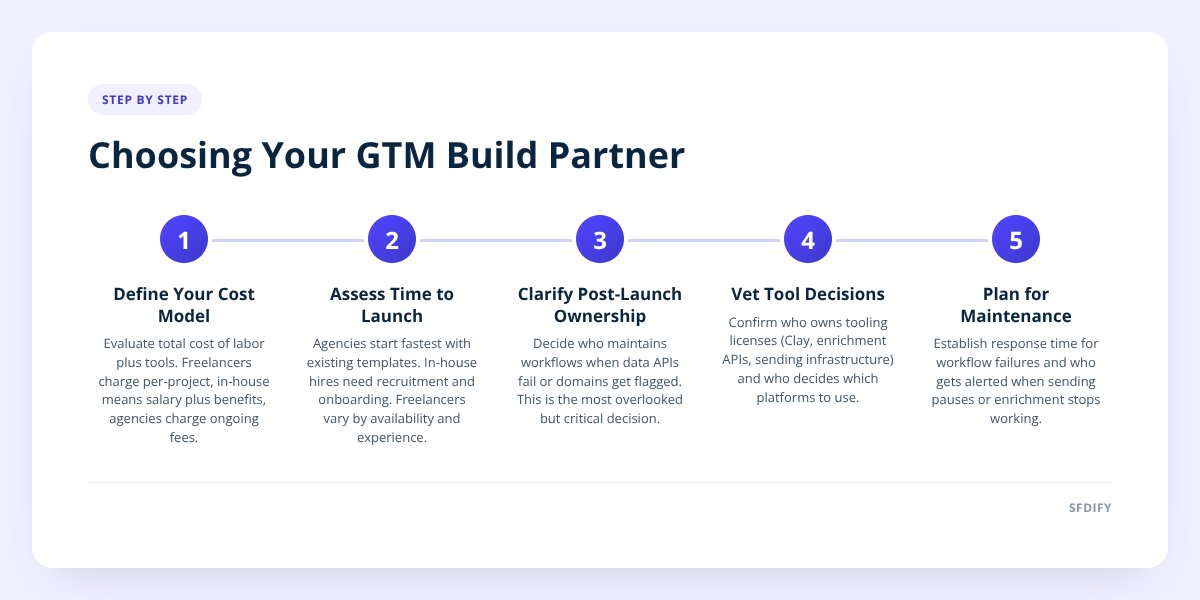
- Cost structure differs by commitment length: a freelancer is usually project-based, an in-house hire carries a full salary plus benefits and tool licenses, and an agency sits between the two with an ongoing engagement fee.
- Tooling and data costs (Clay credits, enrichment providers, email infrastructure) exist in all three models — the question is only who pays for them and who decides which tools to use.
- Maintenance is the most overlooked factor: outbound workflows break when a data source changes or a sending domain gets flagged, and someone has to own fixing that.
- We run these GTM workflows internally at SFDIFY, on our own outbound, for our own products — so we build what we actually operate ourselves.
1. What does each option actually cost?
The honest answer is that none of the three is free of ongoing cost, because the tools behind GTM engineering — enrichment APIs, Clay credits, sending infrastructure — cost money no matter who runs them. The difference is who's paying for labor on top of that.
A freelancer is typically paid per project or per sprint, which keeps upfront cost predictable but means every new workflow is a new negotiation. An in-house hire means a full salary, benefits, and the tool budget, which only makes sense once outbound is a permanent, growing function. An agency usually charges an ongoing fee that covers both the build and a level of upkeep, which spreads cost but requires trusting someone outside the company with your data and sending reputation.
| Model | Cost structure | How fast work starts | Who owns tooling costs |
|---|---|---|---|
| GTM agency | Ongoing engagement fee | Fast — existing workflows and templates to adapt | Often bundled or passed through, confirm before signing |
| In-house hire | Salary + benefits + tools | Slow — hiring, onboarding, ramp-up | Company pays directly, full control |
| Freelancer | Per-project or hourly | Fast to moderate, depends on availability | Usually billed to the client separately |
Our take: if outbound is core to how you sell and will stay that way for years, hire in-house and own it fully. If you need working workflows now and don't want to manage infrastructure, an agency is the faster, lower-friction path. A freelancer makes sense only when the project has a firm scope and you already have someone internal who can maintain it once they're gone.
2. How fast does work actually start?
Speed depends on what already exists versus what has to be built from zero. An agency that already runs these workflows — Clay tables, enrichment waterfalls, scoring logic — can usually adapt existing patterns to a new account faster than someone starting from a blank workspace. An in-house hire has to be sourced, interviewed, and onboarded before they write a single workflow, which is the slowest path by design.
A freelancer sits in between: fast if you find someone with direct Clay and outbound automation experience, slower if you're vetting from scratch. The real bottleneck for all three is rarely the hiring step — it's access. Whoever builds your GTM workflows needs CRM access, sending domain control, and a clear ICP definition before they can do anything useful.
We covered what this type of build actually involves in What Is a GTM Engineer, and What Do They Actually Build? — worth reading before you scope any of the three options, because it defines the job you're hiring for.
3. Who owns the workflow once it's live?
Ownership is the single biggest difference between the three, and it's the one founders underweight most. A workflow that enriches leads, scores them against your ICP, and triggers outbound isn't a one-time deliverable — it needs someone watching when a data provider changes its API, when a sending domain gets flagged, or when your ICP definition shifts because you launched a new product line.
With an in-house hire, ownership is total and immediate: they built it, they maintain it, institutional knowledge stays inside the company. With a freelancer, ownership typically ends at project handoff — unless you've explicitly contracted for maintenance, you're on your own when something breaks. With an agency, ownership is shared by design: they maintain the workflow, but you depend on their availability and their continuity of staff.
before you sign anything, ask who gets paged when a workflow silently stops sending — if nobody can answer that in one sentence, don't sign yet.
A simplified version of what breaks and needs a human to catch it:
if enrichment_response.status != 200:
    alert_owner("enrichment source failed")
if domain_reputation.score < threshold:
    pause_sending()
    alert_owner("sending paused")
Someone has to own responding to that alert. Decide who, before you decide who builds the workflow in the first place.
4. Questions to ask any GTM agency before you sign
Ask these before signing, not after the first workflow breaks. The answers tell you more about fit than any pitch deck will.
- Ask which specific tools they build in (Clay, enrichment providers, sending platforms) and whether those licenses are yours or theirs.
- Ask who maintains the workflow after launch and what their response time is when something breaks.
- Ask what happens to the workflows, data, and account access if you end the engagement.
- Ask for a plain description of how they define and score an ICP, not a generic answer.
- Ask whether your sending domain and reputation are isolated from other clients' sending activity.
- Ask whether they've built and run outbound for their own company, not only for clients.
- Ask how pricing changes as volume or complexity grows, so there's no surprise later.
That last question matters more than it sounds. An agency that has never run its own outbound is asking you to trust a system they've only operated for other people. At SFDIFY, we run GTM engineering workflows internally, on our own outbound, for our own products — we build what we already use ourselves.
5. What signals mean you should hire in-house instead?
Hire in-house when outbound is a permanent, growing part of how you sell — not a project with an end date. A few concrete signals point that direction:
- Your outbound volume is large enough that one person's full-time attention is clearly justified.
- Your ICP and messaging change often enough that someone needs to be embedded in sales conversations daily.
- You need deep Salesforce or CRM integration that touches core business logic, not just lead routing.
- Data sensitivity or compliance requirements mean you can't have workflows running outside your own infrastructure.
- You've already outgrown an agency or freelancer engagement twice and keep hitting the same ownership gap.
If none of those are true yet, in-house is premature. Hiring a full-time person before outbound volume justifies it usually means an underused employee and a stalled workflow, which is worse than a well-run agency engagement.
6. How this shapes the way we build for clients
Because we run these workflows on our own outbound before we build them for anyone else, we don't hand off a workflow and disappear — we build the same Clay tables and enrichment logic we rely on ourselves, documented well enough that a client's team can eventually take it over if that's the goal. That's also why we're direct about limits: we build GTM engineering — Clay workflows, lead enrichment, ICP scoring, outbound automation — and we don't position that as revenue operations or RevOps work. If your need is broader CRM or Salesforce process design, that's a different conversation, one we cover in Hire a Salesforce Administrator: In-House or Outsourced.
If you're weighing these three options for your own outbound, start a project with SFDIFY and we'll talk through which one actually fits where you are.
Checklist: Choosing between a GTM agency, in-house hire, and freelancer
- Map your expected outbound volume for the next year before pricing out any option.
- Write down your ICP definition in plain language — if you can't, no hire will fix that gap.
- List every tool a workflow depends on (CRM, enrichment, sending platform) and who pays for each.
- Ask any agency candidate who maintains workflows after launch and what their response time is.
- Confirm in writing what happens to your data and workflows if the engagement ends.
- Identify who inside your company would take over a workflow if an outside builder left.
- Decide whether this is a one-time project or a permanent function before you pick a model.
Checklist: Choosing between a GTM agency, in-house hire, and freelancer
- Map your expected outbound volume for the next year before pricing out any option.
- Write down your ICP definition in plain language — if you can't, no hire will fix that gap.
- List every tool a workflow depends on (CRM, enrichment, sending platform) and who pays for each.
- Ask any agency candidate who maintains workflows after launch and what their response time is.
- Confirm in writing what happens to your data and workflows if the engagement ends.
- Identify who inside your company would take over a workflow if an outside builder left.
- Decide whether this is a one-time project or a permanent function before you pick a model.