 SFDIFY
- Write your ICP in one paragraph and confirm the whole sales team agrees with it.
- Track how many hours per week reps currently spend building and enriching lists by hand.
- Confirm a CRM is already in place and being used consistently.
A GTM engineer is not a sales rep with a fancier title and not a developer who got bored with internal tools. The role exists because outbound sales now runs on data: lists, scores, signals, and the pipes that move them into a CRM. We built this function for our own outbound before we ever offered it to a client, which is the only way we'd recommend building it.
A GTM engineer (go-to-market engineer) builds and maintains the data and automation layer behind outbound sales — sourcing lead lists, enriching them with firmographic and contact data, scoring accounts against an ideal customer profile (ICP), monitoring buying signals, and wiring all of it into the CRM and sequencing tools so reps work warm, ranked lists instead of cold spreadsheets. They sit between sales, marketing, and engineering, but report to none of them exclusively.
- A GTM engineer's output is infrastructure, not conversations — lists, scores, and automated workflows, not calls or emails sent in their own name.
- The role typically centers on tools like Clay, Apollo, Clearbit, or similar enrichment platforms, wired into a CRM such as Salesforce or HubSpot.
- A company is usually ready for one once it has a defined ICP and an existing outbound motion that's outgrowing manual list-building — not before.
- GTM engineering is distinct from revenue operations; it focuses on the front end of the pipeline (who to target and when), not forecasting or quota management.
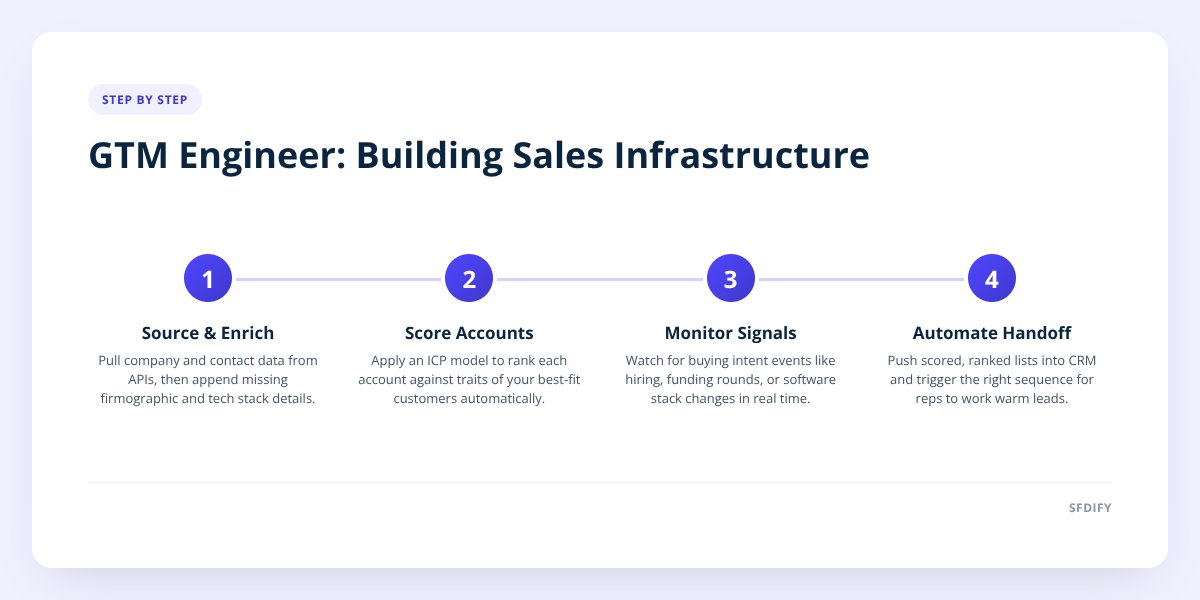
1. What does a GTM engineer actually build, day to day?
A GTM engineer spends most of a week building and repairing pipelines that turn raw company and contact data into a ranked, enriched list a sales rep can act on. The work is closer to data engineering than to sales.
A typical build includes:
- Sourcing: pulling lists of companies and contacts from databases like Apollo, Clearbit, or LinkedIn Sales Navigator based on firmographic filters.
- Enrichment: appending missing data — company size, tech stack, funding stage, job titles — usually through a tool like Clay that chains multiple data providers together.
- ICP scoring: applying a scoring model that ranks each account or contact against the traits of a company's best-fit customers.
- Signal monitoring: watching for events that suggest buying intent, such as a company hiring for a relevant role, raising funding, or changing a key piece of software.
- Handoff automation: pushing the finished, scored list into the CRM and triggering the right sequence in a tool like Outreach, Salesloft, or Apollo's sequencer.
At SFDIFY, we run this exact workflow internally on our own outbound, for our own products — building for clients what we already use ourselves. We don't attach numbers to it publicly, but the shape of the work is the same whether it's feeding our pipeline or a client's.
2. How is a GTM engineer different from a sales rep?
A sales rep talks to prospects; a GTM engineer builds the system that decides who the rep talks to and in what order. The rep's job is persuasion and relationship-building. The GTM engineer's job is making sure the rep's time is spent on the accounts most likely to convert, not on a list pulled at random from a database.
A sales rep might notice, over months, which types of companies tend to close. A GTM engineer codifies that pattern into a scoring model that runs automatically, every day, across thousands of accounts — something no rep has time to do by hand.
The two roles depend on each other. A GTM engineer with no sales input is scoring against a guess. A rep with no GTM engineering support is doing manual research that a workflow could do faster.
3. How is this different from a marketer or a general software engineer?
A marketer builds demand at scale through content, ads, and campaigns aimed at an audience that doesn't yet know the company exists. A GTM engineer works downstream of that — taking a defined ICP, often shaped by marketing's own research, and building the targeting and automation layer that feeds specific, named accounts into outbound.
A general software engineer builds and maintains the company's actual product — the application customers pay for. A GTM engineer builds internal tooling that happens to serve the sales process, using off-the-shelf platforms (Clay, Salesforce, Apollo) wired together with API calls and workflow logic, rather than building a customer-facing product from scratch.
| Role | Primary output | Tools |
|---|---|---|
| Sales rep | Conversations, closed deals | CRM, phone, email, sequencer |
| Marketer | Demand, content, campaigns | Ad platforms, CMS, analytics |
| GTM engineer | Enriched lists, ICP scores, signal alerts, CRM pipelines | Clay, Apollo, Clearbit, CRM APIs |
| Software engineer | The product customers pay for | Full application stack |
The overlap that confuses people: a GTM engineer does write code and does use APIs, which makes the title sound like a developer role. The difference is what gets built — a workflow that feeds a sales team, not a product that generates revenue on its own.
4. When is a company actually ready for a GTM engineer?
A company is ready once it has a documented ICP and an outbound motion that's already outgrowing manual list-building — not before. If nobody on the team can describe, in specific terms, what a good-fit customer looks like, a GTM engineer has nothing to score against.
Signs a company is ready:
- Reps are spending hours per week building and cleaning prospect lists by hand.
- The ICP is documented well enough that someone could write scoring rules from it.
- Outbound volume has grown past what one person can enrich and route manually.
- There's already a CRM and sequencing tool in place that a workflow can plug into.
Signs it's too early:
- The company hasn't closed enough deals to know what its best customers have in common.
- There's no CRM yet, or the sales process itself is still changing month to month.
- Outbound volume is low enough that a founder or one rep can still do it by hand without strain.
if you can't write your ICP down in one paragraph, a GTM engineer has nothing to automate yet — fix the targeting first.
A rough version of a scoring rule, before any tool gets involved, might look like this:
score = 0
if employee_count between 50 and 500: score += 2
if industry in [target_list]: score += 2
if recently_hired("VP Sales"): score += 1
if uses_tool("Salesforce"): score += 1
route_to_sequence if score >= 4
That logic is what a GTM engineer turns into a running workflow — reading data on a schedule, scoring it, and pushing qualified accounts forward automatically.
Checklist: deciding if your company needs a GTM engineer
- Write your ICP in one paragraph and confirm the whole sales team agrees with it.
- Track how many hours per week reps currently spend building and enriching lists by hand.
- Confirm a CRM is already in place and being used consistently.
- List the data providers (Clearbit, Apollo, ZoomInfo, or similar) you'd need enrichment from.
- Define what a buying signal looks like for your market — a hire, a funding round, a tool switch.
- Decide whether scoring rules can be written down today or still need more closed deals first.
- Map out where a scored list would hand off into your sequencing tool.
How this shapes the way we build GTM systems for clients
We don't build revenue operations systems, run forecasting, or manage quotas — that's a different discipline. What we build is the targeting and automation layer: enrichment, ICP scoring, signal monitoring, and the pipeline that connects a data source to a CRM and a sequencer, the same workflow we run on our own outbound. If a company is weighing whether to build this in-house or bring in outside help, the same questions we covered in how to evaluate AI automation tools before hiring an agency apply here: start with what the workflow needs to do, not which tool has the most features.
Because GTM engineering sits next to CRM work, companies that reach this stage are often also rethinking their CRM setup. We've covered that decision separately in CRM selection: custom, Salesforce, or off-the-shelf.
If you're trying to figure out whether your outbound process is ready for this layer, or what it would take to build it, SFDIFY offers a free first consultation. You can read more about the specific workflows on our GTM engineering page, or start a project directly at sfdify.com/contact.
Checklist: deciding if your company needs a GTM engineer
- Write your ICP in one paragraph and confirm the whole sales team agrees with it.
- Track how many hours per week reps currently spend building and enriching lists by hand.
- Confirm a CRM is already in place and being used consistently.
- List the data providers (Clearbit, Apollo, ZoomInfo, or similar) you'd need enrichment from.
- Define what a buying signal looks like for your market — a hire, a funding round, a tool switch.
- Decide whether scoring rules can be written down today or still need more closed deals first.
- Map out where a scored list would hand off into your sequencing tool.