SFDIFY

For most small and mid-size sales teams, the HubSpot competitors worth shortlisting first are Zoho CRM, which is "Forever free, for 3 users" and starts at US$14 per user per month billed annually [1]; Pipedrive, from US$14 per seat per month billed annually [2]; and Salesforce Starter Suite at $25 per user per month [3]. monday CRM, folk and Keap fit narrower needs. HubSpot's own free tier covers up to 2 users, so measure every alternative against that baseline before you switch [4].
How we chose
We compared six HubSpot alternatives on the things that decide a CRM purchase for a team of roughly 2 to 50 sellers: entry price, what the cheapest useful plan actually includes, billing and contract terms, and where each product is weaker. Every fact below comes from the vendors' own homepages and pricing pages, checked on November 8, 2026. We did not run hands-on tests, and CRM prices change often, so confirm the numbers on the vendor page before you buy. Products are ordered by how broadly they fit small and mid-size sales teams, not by whether we earn a commission.
What HubSpot offers today
A fair comparison starts with what you would be leaving. HubSpot describes its free CRM as "100% free with no expiration date" [5]. The free account allows up to 2 users and 1,000 contacts [4]. Starter "is normally priced at $20/month per seat," and new customers can get a limited-time discount to $7 per seat with an upfront annual payment, or $10 per seat month to month [4]. Starter removes HubSpot branding and adds automation, AI agents, payments, meeting scheduling and e-signatures [4].
That is a strong starting offer. Teams usually look at alternatives to HubSpot for specific reasons: they need more than two people on a free plan, they want a tool built only around the sales pipeline, or they want a predictable price once an introductory discount ends. If HubSpot's free plan already covers your team, staying put is a reasonable choice.
HubSpot competitors at a glance
| Product | Best for | Starting price | Notable |
|---|---|---|---|
| Zoho CRM | Budget-conscious teams that want depth | Free for 3 users; Standard US$14/user/month billed annually [1] | AI agents and CPQ on Professional [1] |
| Pipedrive | Pipeline-focused sales teams | Lite US$14/seat/month billed annually [2] | 14-day free trial; lead capture and campaigns are paid add-ons [2] |
| Salesforce Starter Suite | Teams that expect to grow into Salesforce | $25 USD/user/month [3] | Pro Suite is $100, billed annually, contract required [3] |
| monday CRM | Teams running sales and delivery in one place | Basic $12/seat/month billed yearly [6] | Plans start from 3 users [6] |
| folk | Relationship-led teams working from LinkedIn and email | Standard $24/member/month billed yearly [7] | Email sequences only on Premium [7] |
| Keap | Owner-led service businesses that want marketing automation | $320/mo billed monthly [8] | Required implementation services [8] |
Zoho CRM — the closest match to HubSpot's free-to-paid path
Zoho CRM is the most direct swap for a team that started on HubSpot's free CRM and outgrew it. The free edition gives one more seat than HubSpot's, and the paid tiers climb in small steps.
Verified features: The free edition is "Forever free, for 3 users" and includes workflow automation [1]. Standard adds built-in calling, multiple sales pipelines and sales forecasting, while Professional adds AI agents, inventory management and "Configure, Price, Quote (CPQ)" [1].
Pricing: Billed annually, Standard is US$14, Professional is US$23 and Enterprise is US$40 per user per month. Billed monthly, the same tiers are US$20, US$35 and US$50 [1].
Strengths: A real free tier for a very small team, a low paid entry point and flexible terms. Zoho calls the CRM "a pay-as-you-go service (monthly or yearly)" and says you are not bound by contracts [9].
Limitations: The headline prices assume annual billing; month to month, Standard costs US$20 instead of US$14 [1]. AI agents start on Professional, not Standard [1]. Because the product covers so much ground, expect more configuration decisions than with a pipeline-only tool.
Best fit: Small teams that want a free start today and room to add forecasting, CPQ and automation later without changing vendors.
Pipedrive — built around the sales pipeline
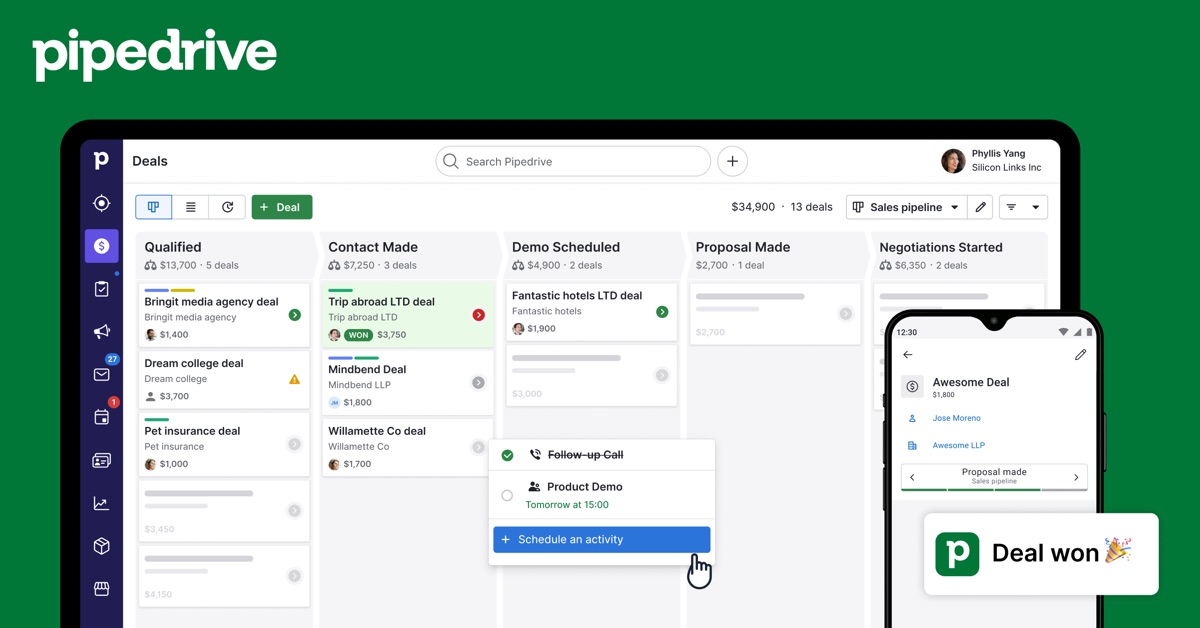
Pipedrive is the most sales-focused tool on this list. It is organized around deal stages rather than a broad marketing suite.
Verified features: Pipedrive offers a "14-day free trial, no credit card required" [10]. The pricing page lists optional add-ons, including LeadBooster for lead capture starting from $32.50 and Campaigns for email marketing starting from $13.33 [2].
Pricing: Lite is US$14, Growth US$39, Premium US$59 and Ultimate US$79 per seat per month, billed annually [2].
Strengths: A clear, pipeline-first design that sales reps can pick up without a long rollout, and a free trial to test it with real deals before anyone pays.
Limitations: The pricing page offers a trial, not a free plan, so it does not replace HubSpot's free tier. Lead capture and email campaigns are paid add-ons [2], so a team that wants marketing in the same tool should add those costs to the seat price. If you need marketing, service and sales in one product, HubSpot or Zoho cover more ground.
Best fit: Small and mid-size sales teams whose main job is moving deals through stages and who already have separate marketing tools.
Salesforce Starter Suite — a growth path on Salesforce
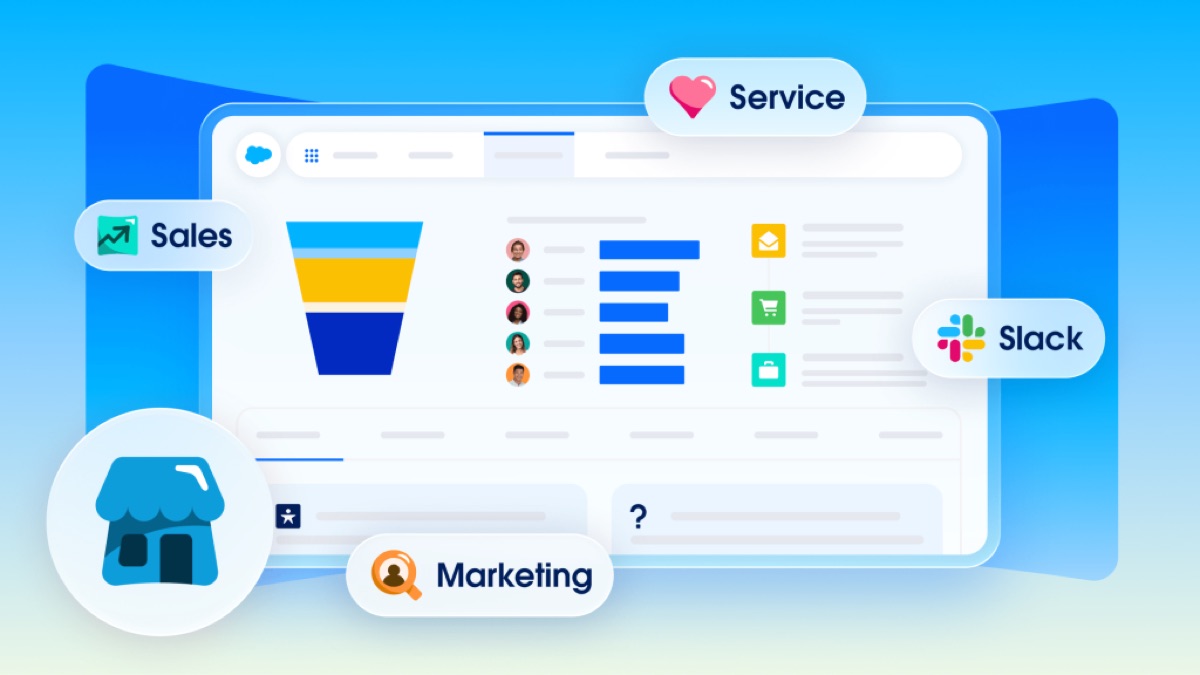
Salesforce Starter Suite is Salesforce's packaged CRM for small businesses. The small business page pitches AI agents that "take on work across sales, service, and marketing" [11].
Verified features: Starter includes "Dynamic Email Nurture Campaigns and Lead Scoring," "Built-in Sales Flows and Lead Routing" and a free Slack workspace connected to the CRM [3]. Pro Suite adds "Sales Quoting and Forecasting" and access to AppExchange [3].
Pricing: Starter Suite is $25 USD per user per month, billed monthly or annually, and the page notes "Transaction fees apply" [3]. Pro Suite is $100 USD per user per month, "Billed annually. Contract required." [3]
Strengths: Salesforce states there is "no user maximum" on Starter [3], and the same platform runs much larger sales organizations, so a growing team does not have to migrate again later.
Limitations: The step from Starter to Pro Suite is a fourfold price jump with an annual contract [3]. Teams usually need someone to own configuration as they add custom objects and automation; our Salesforce consulting work exists for exactly that stage.
Best fit: Sales teams that are small today but expect to need quoting, forecasting and a large app ecosystem within a year or two.
monday CRM — sales and post-sale work on one board
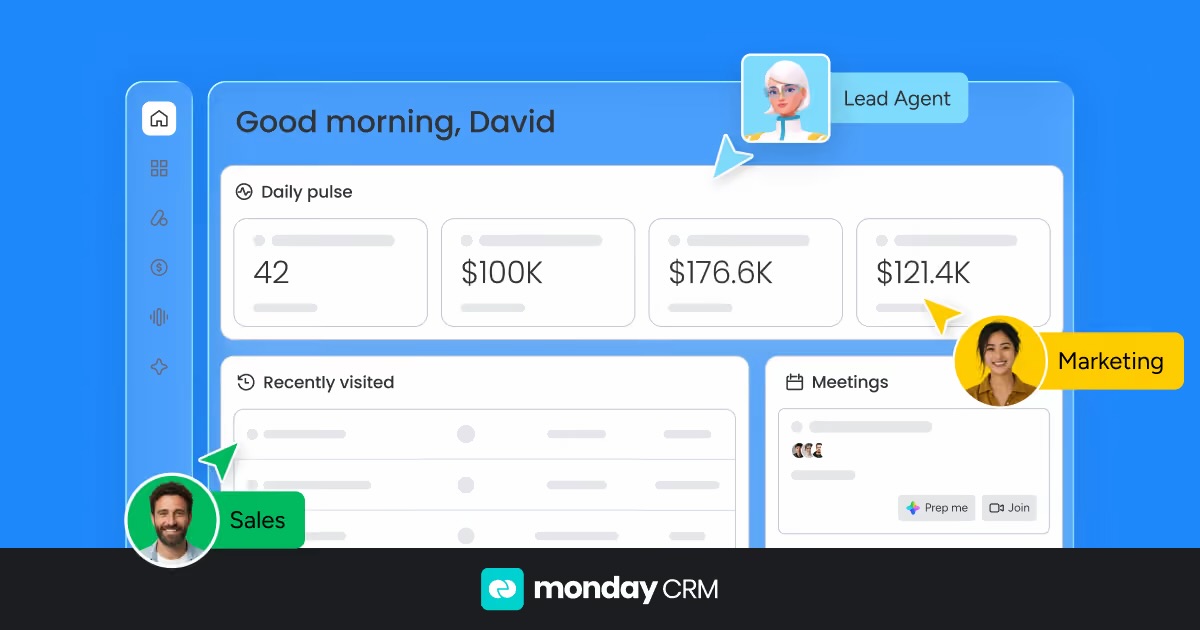
monday CRM suits teams whose sales work runs straight into delivery. It describes itself as a CRM "that puts marketing, sales, and delivery on one platform" [12].
Verified features: Basic covers 1,000 active contacts and deals; Standard raises that to 10,000 with 250 custom automations per month; Pro allows 100,000 and adds mass emails and email sequences [6].
Pricing: Billed yearly, Basic is $12, Standard $17 and Pro $28 per seat per month; billed monthly, they are $18, $25 and $41 [6]. "Plans start from 3 users." [6]
Strengths: One workspace for pipeline, onboarding and project handoff, with custom automations included from Standard.
Limitations: There is no free plan; monday says the first free option is a 14-day trial [6]. The three-seat minimum matters for solo founders [6]. Mass email and sequences require Pro [6], which puts outbound email at a higher tier than Zoho or Pipedrive's entry plans.
Best fit: Agencies and service teams that want sales, onboarding and delivery tracked in one place.
folk — a lightweight CRM for relationship-driven teams
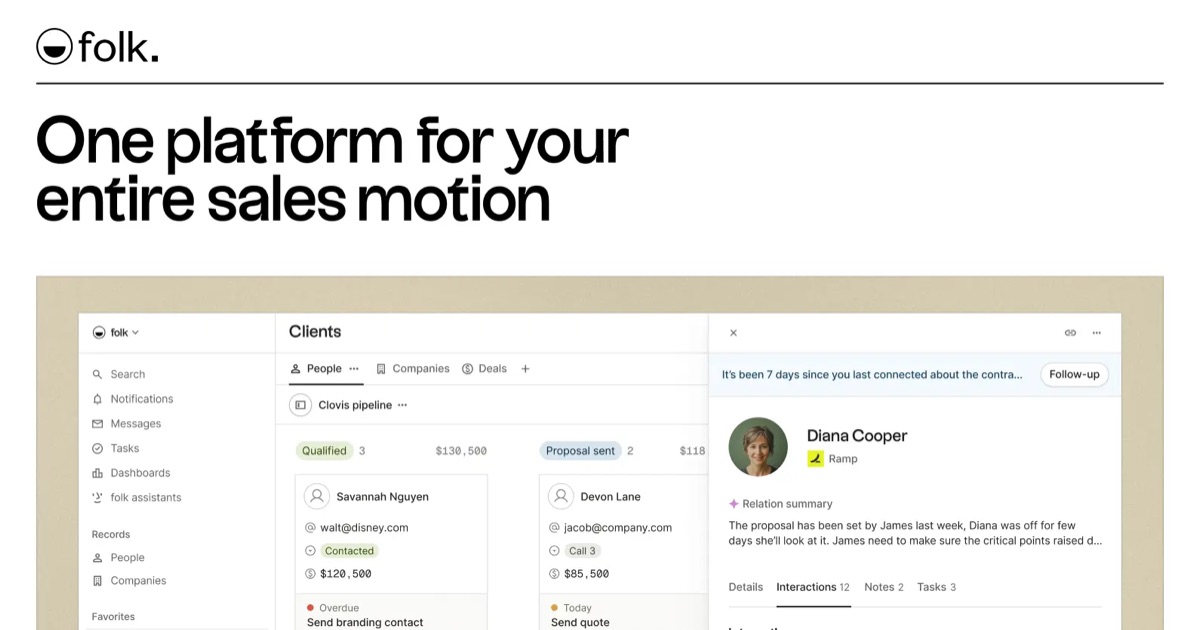
folk is a lighter option for founders, agencies and partnership teams whose deals start in LinkedIn and email. It calls itself "The AI CRM for your entire sales motion" [13].
Verified features: Standard includes pipeline management, email campaigns, contact enrichment, a LinkedIn extension and "Email, calendar & WhatsApp sync" [7]. Premium adds custom objects and deals, email sequences, dashboards and API access [7].
Pricing: Billed yearly, Standard is $24 and Premium $48 per member per month; billed monthly, they are $30 and $60 [7]. folk activates a 2-week free trial and does not ask for a credit card [7].
Strengths: Quick setup around tools a small team already lives in, with enrichment and campaigns on the entry plan.
Limitations: Deals as custom objects, email sequences and dashboards sit on Premium [7], so a structured sales team may need the $48 tier. The entry price is higher than Zoho or Pipedrive.
Best fit: Relationship-led teams of a few people who prospect on LinkedIn and want a CRM that stays out of the way.
Keap — marketing automation for owner-led service businesses
Keap targets small businesses that want automated follow-up more than a classic sales pipeline. It packages CRM, email automation and invoicing in one product.
Verified features: Keap lists automatic lead follow-up, landing pages and forms, broadcast and 1:1 email, and automatic invoicing [14].
Pricing: Keap shows "Starting at $320/mo (Billed monthly)" for its default of 2 users and 1,500 contacts [8]. Additional users are $39 per month each [8].
Strengths: Marketing automation, invoicing and CRM in one platform, aimed at service businesses that sell through follow-up sequences.
Limitations: It has the highest entry price here, and the pricing page lists "Required implementation services" [8]. Cancelling an annual contract early carries a $299 early termination fee [8]. The free trial is limited to 25 emails, with no payment processing and no texting [8].
Best fit: Coaches, consultants and local service firms that want marketing automation and invoicing in one platform, and that can budget for implementation.
How to choose among HubSpot CRM alternatives
- Count seats and contacts first. Free tiers differ: HubSpot allows 2 users [4] and Zoho 3 [1]. monday sets contact limits per plan and starts at 3 seats [6].
- Decide between a pipeline tool and a platform. Pipedrive and folk focus on deals and relationships. Zoho, Salesforce and HubSpot are broader platforms, which means more setup.
- Read the billing terms. Most headline prices assume annual billing. Salesforce Pro Suite requires a contract [3], and Keap charges a fee to cancel an annual contract early [8].
- Add up the add-ons. Pipedrive's lead capture and campaigns are priced separately [2].
- Know when off-the-shelf stops fitting. If your process does not fit any of these, compare the options in our guide to choosing between custom, Salesforce or off-the-shelf CRM, or look at custom CRM development.
FAQ
What are the best free HubSpot alternatives?
Of the products here, Zoho CRM has a permanent free edition, "Forever free, for 3 users" [1]. Pipedrive, monday CRM and folk offer trials instead: 14 days for Pipedrive [2] and monday CRM [6], and 2 weeks for folk [7]. For more free options, see our list of free CRM software.
Which HubSpot alternatives for small business cost the least?
On annual billing, Zoho CRM Standard and Pipedrive Lite both start at US$14 per user or seat per month [1] [2], and monday CRM Basic starts at $12 per seat per month with a 3-user minimum [6]. Keap is the most expensive entry point at $320 per month [8].
How does Salesforce Starter compare with HubSpot Starter?
HubSpot Starter is normally $20 per seat per month, with a limited-time new-customer price of $7 on annual billing [4]. Salesforce Starter Suite is $25 per user per month, billed monthly or annually [3]. Salesforce's next tier, Pro Suite, is $100 per user per month with a contract [3].
Do competitors to HubSpot require annual contracts?
It varies. Zoho says it does not bind you to contracts [9]. Salesforce Pro Suite is billed annually with a contract required [3]. Keap charges a $299 fee if you cancel an annual contract early [8]. monday CRM allows monthly payment, but monthly plans are not discounted [6].
Our recommendation
Start by checking whether HubSpot's free tier still fits; if you need more seats on a free plan, Zoho CRM is the closest replacement. Choose Pipedrive if your team lives in the pipeline and already has marketing tools, and Salesforce Starter Suite if you expect to grow into a larger platform. monday CRM, folk and Keap are strong in narrower cases: delivery-heavy teams, LinkedIn-led selling and automation-heavy service businesses. Run a trial with real deals before you commit to annual billing.
Sources
- Zoho CRM Pricing and Editions - Free for 3 users — checked 2026-11-08
- CRM Pricing Plans | Affordable CRM Software Costs | Pipedrive — checked 2026-11-08
- Salesforce Small Business Pricing: All-in-One CRM Solutions | Salesforce — checked 2026-11-08
- Free Tools | HubSpot — checked 2026-11-08
- Free CRM Software for Small Businesses | HubSpot — checked 2026-11-08
- monday.com CRM pricing: find the plan that works for you — checked 2026-11-08
- folk CRM Pricing — Free, Standard & Premium Plans — checked 2026-11-08
- Keap Pricing | Best CRM and Automation for Businesses — checked 2026-11-08
- Zoho CRM | Top-rated Sales CRM Software by Customers — checked 2026-11-08
- Sales CRM & Pipeline Management Software | Pipedrive — checked 2026-11-08
- Small Business CRM with AI Agents | Salesforce — checked 2026-11-08
- AI CRM Software | monday CRM - Revenue Execution Platform — checked 2026-11-08
- The AI CRM for your entire sales motion — checked 2026-11-08
- Small Business CRM & Automation | Keap — checked 2026-11-08